




Yakshagana : Traditional Folk Theatre & Dance Drama of Coastal Karnataka | Yakshagana History, Origin & Styles: Moodalapaya & Paduvalapaya | Performers: Himmela & Mummela | Music, Dance, Rasa & Instruments | Costumes, Makeup & Stage Customs : Complete Guide | Seethapahara: The Abduction of Sita, a Spellbinding Yakshagana Performance by Sri Idagunji Mahaganapati Yakshagana Mandali (Keremane Troupe), Led by Dr. Keremane Shivananda Hegde, in Collaboration with SPIC MACAY, Supported by the Guru Krupa Foundation | Best Places to Watch Yakshagana in Karnataka (Updated)
– a sacred folk theatre & dance drama from udupi to kundapura & uttara kannada
| CasualWalker’s Rating for Yakshagana Performance by Sri Idagunji Mahaganapati Yakshagana Mandali (Keremane Troupe) : | |

9.9 – Mesmerising, Divine, Vibrant |
|

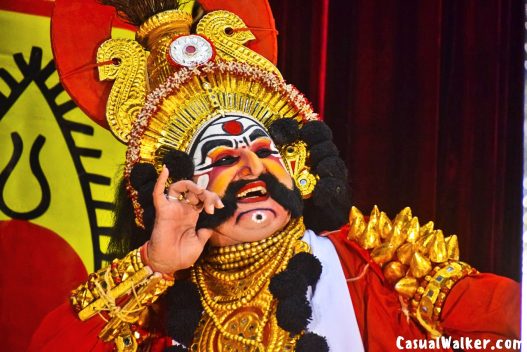
Yakshagana is a traditional folk theatre and dance drama native to coastal Karnataka. The word Yakshagāna comes from two Sanskrit roots: Yaksha, meaning nature spirits or celestial beings, and Gāna, meaning song. Yakshas are also the guardians of the natural treasures hidden inside the earth. So it is, quite literally, the song of the celestials. 
Origin of Yakshagana
Yakshagana is a rich and time honoured art form performed in the Dakshina Kannada, Udupi and Uttara Kannada districts of Karnataka, and in Kasaragod in Kerala. Parts of the Western Ghats region, such as Shivamogga, Chikkamagaluru and Kodagu, also keep the tradition alive. It holds dance, music, costume, makeup, spoken word and the older art traditions of the land in one frame.
In some parts of Karnataka it was called Bayalata, which simply means a play performed in the open air. Sister art forms include Therukoothu of Tamil Nadu, Kutiyattam and Chakyarkoothu of Kerala, and Veedhinatakam of Andhra Pradesh. Yakshagana is mostly presented in Kannada, but on certain occasions it is also performed in Tulu and Malayalam. The music, dialogue and dance are sometimes improvised, so no two performances are ever the same.
History & Significance of Yakshagana
The Yakshagana art form rose between the 11th and 16th centuries and grew from the Bhakti movement (the path of loving devotion), which celebrated Lord Vishnu and Lord Shiva and blended classical traditions with folk expression. Tradition credits the saint Narahari Tirtha with staging early Dashavatara performances in Udupi in the 13th century, which later shaped Yakshagana as we know it.
The earliest written evidence is an inscription dated 1556 at the Lakshminarayana Temple in Kurugodu, Ballari district. Parthi Subba of Kumble is widely regarded as the father of Yakshagana, since he composed some of the first prasangas, the story episodes used in performance. In the 20th century, the celebrated writer and thinker Dr K. Shivarama Karanth gave the art new life through thoughtful experiments, and his work brought wider acceptance and popularity.
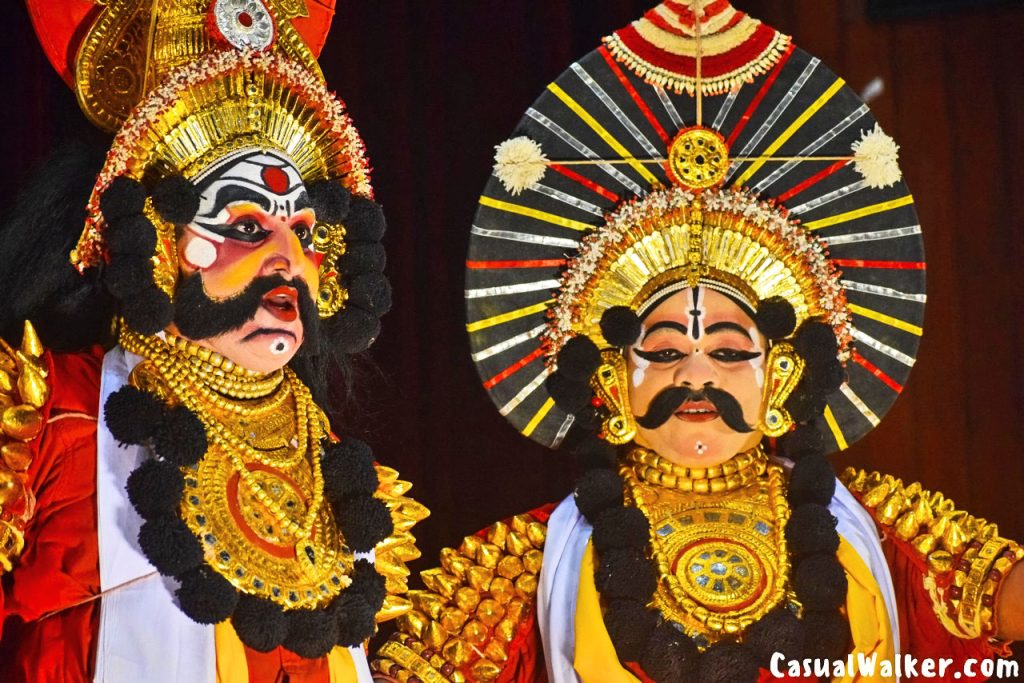
The art holds deep cultural value. It keeps alive the epics, the Puranas and the moral lessons of Dharma (righteous duty) and Karma (action and its fruit) for ordinary people, village after village. Many believe it also carries older roots of Bhuta worship (worship of local spirits and deities, called Bhootaradhane) and snake worship (Nagamandala), similar to Bhoota Kola and Theyyam, while borrowing structure from Bharata’s Natyashastra and Sanskrit drama.
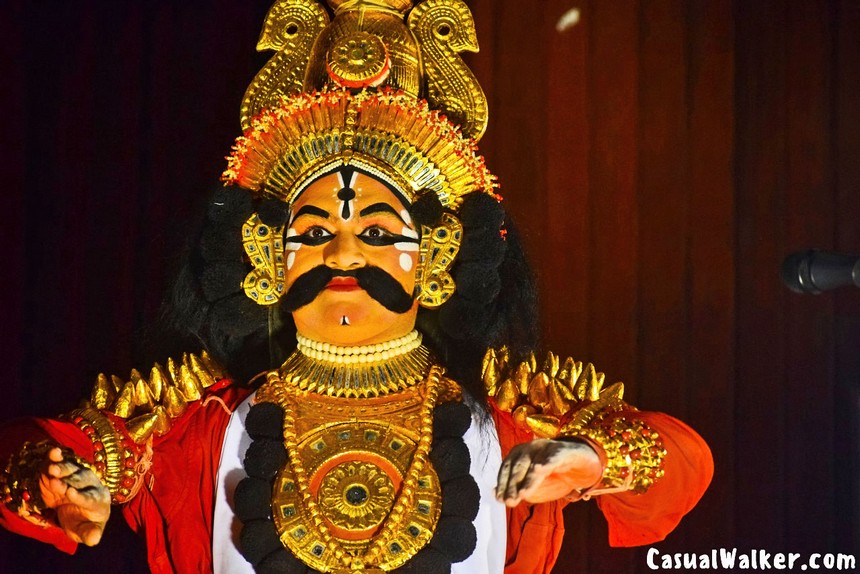
Yakshagana Styles : Moodalapaya & Paduvalapaya
There are two broad styles. Moodalapaya is the older eastern form, known in parts of north Karnataka. Paduvalapaya is the western form, also called coastal Yakshagana, and it is the more refined and popular one, most often shown to visitors.
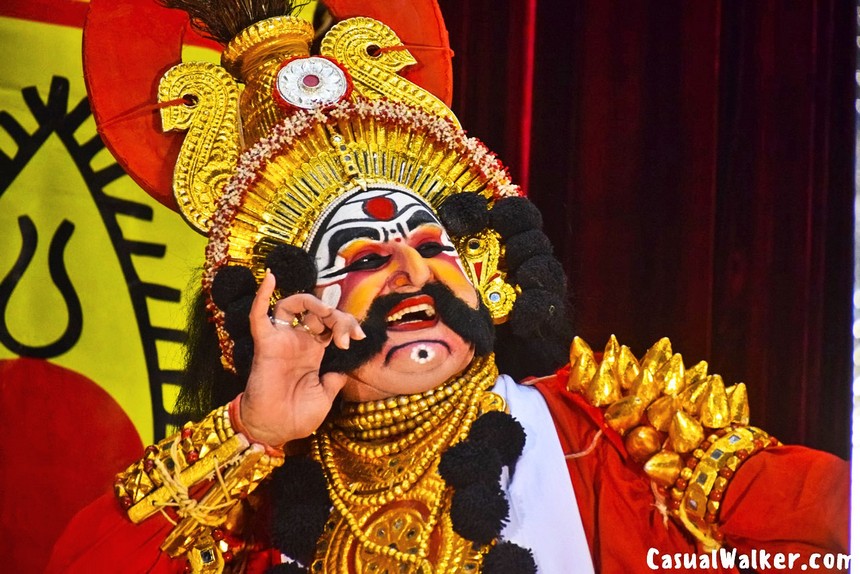
Paduvalapaya has two schools. Tenkutittu, the southern style, is common around Mangaluru, Puttur, Sullia, Belthangady, Karkala and Kasaragod, and it shows strong colour traditions, a dramatic presence and some Karnatic music influence. Badagutittu, the northern style, is strong from Udupi to Kundapura and into Uttara Kannada, and it gives more weight to facial expression and dialogue.
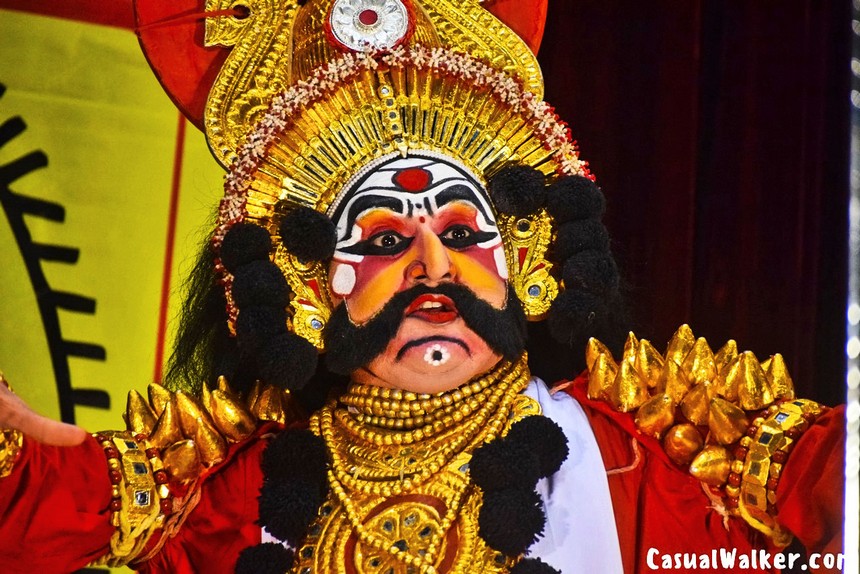
Stories Behind the Stage
The tales come from the Ramayana, the Mahabharata and the Bhagavata Purana, and also from Jain and other ancient Indian traditions. Each night, a short episode called a prasanga is chosen, such as the tale of Lord Rama and Lord Hanuman, or the battle scenes of Lord Krishna and the Pandavas. Plays in Kannada, Tulu and Telugu, along with local folklore, have been added over time. Even in stories of war, the message points to Satya (truth) and the victory of Dharma over Adharma (unrighteousness).
Performers: Himmela and Mummela
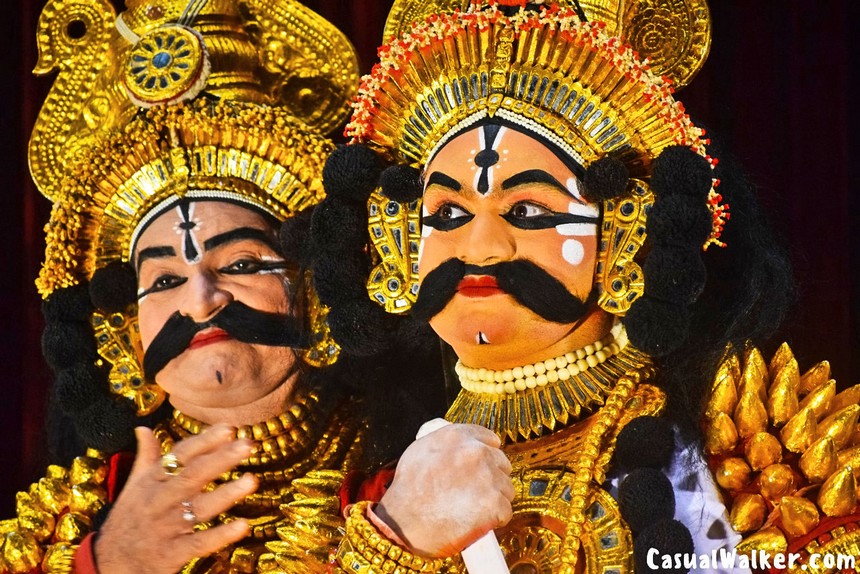
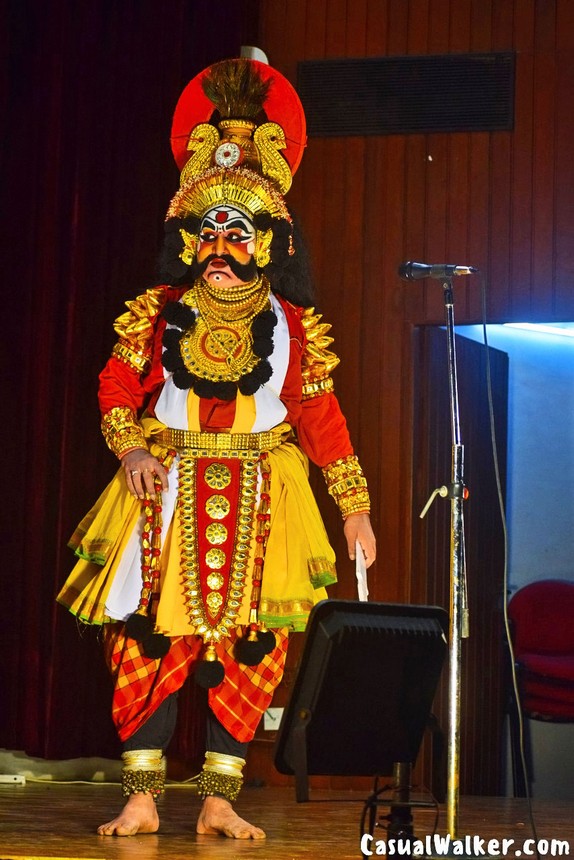
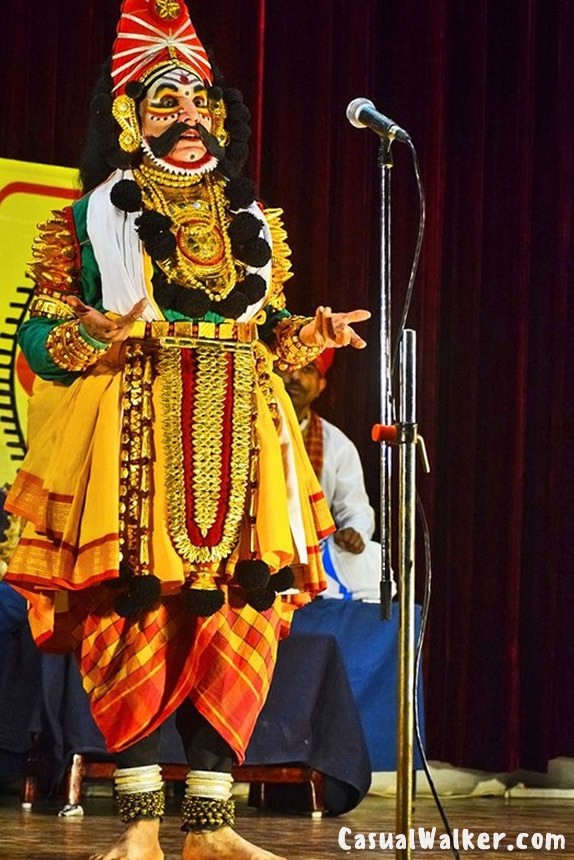
The troupe has two groups. The Himmela is the group at the back, made up of the singer and musicians. The Mummela is the group in front, the actors who tell the tale through dance and dialogue.
The Bhagavata is the lead singer, director and storyteller who holds the whole performance together. He sings, narrates, guides the pace, keeps the beat with finger cymbals and adds light humour. A typical troupe has fifteen to twenty actors along with the Bhagavata. For centuries men played every role, including female characters, with a grace that surprised many viewers. Today women and children are proud members of troupes, and some groups are entirely made up of women.
Music, Rhythm and Instruments
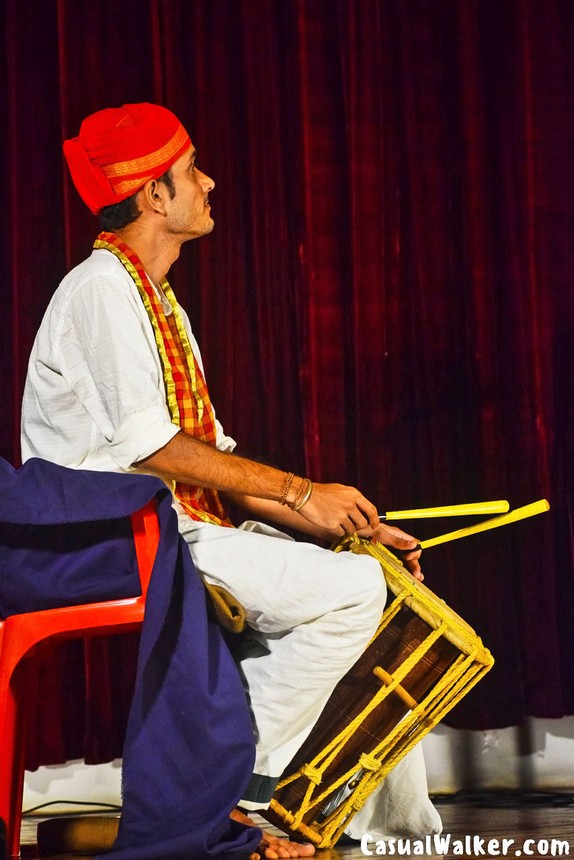
Music leads everything here, much like the sacred sound (Nada) in Indian spiritual thought. The main instruments are the chende, a high pitched drum played with two sticks, the maddale, a barrel shaped drum, the harmonium, the flute, and small cymbals called taala or jagate. The chende can be heard across fields, and in older days it told faraway villages that the night’s performance had begun.
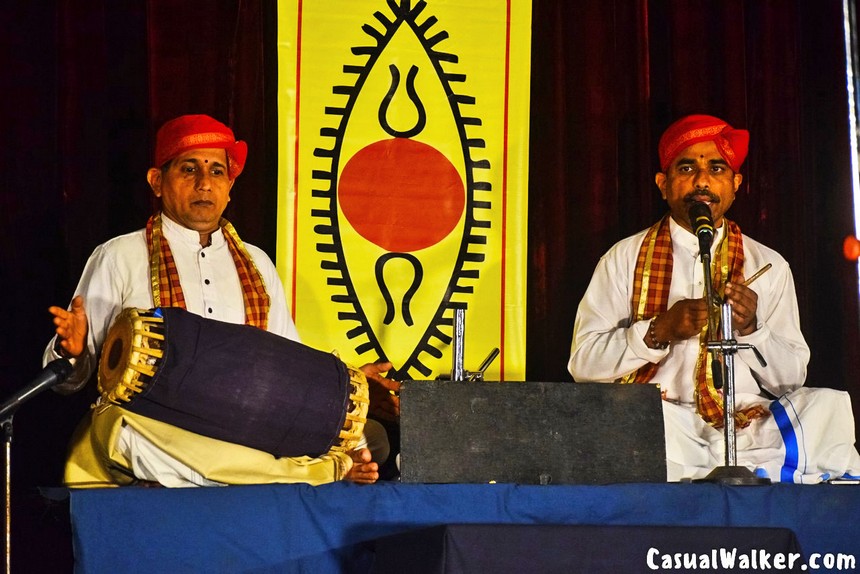
The Bhagavata sings in a high pitch, which once carried to large audiences without microphones, and some see it as symbolic, since the night belongs to Adharma and order returns with the day. The verses follow Sanskrit and Kannada metres and seven main rhythm cycles (Tala). Beats called muktaya mark the close of one phase and the start of the next, guiding the actors from song to dance and from dance to speech. It is a rhythm that moves the heart before it moves the feet.
Dance, Expression and Rasa
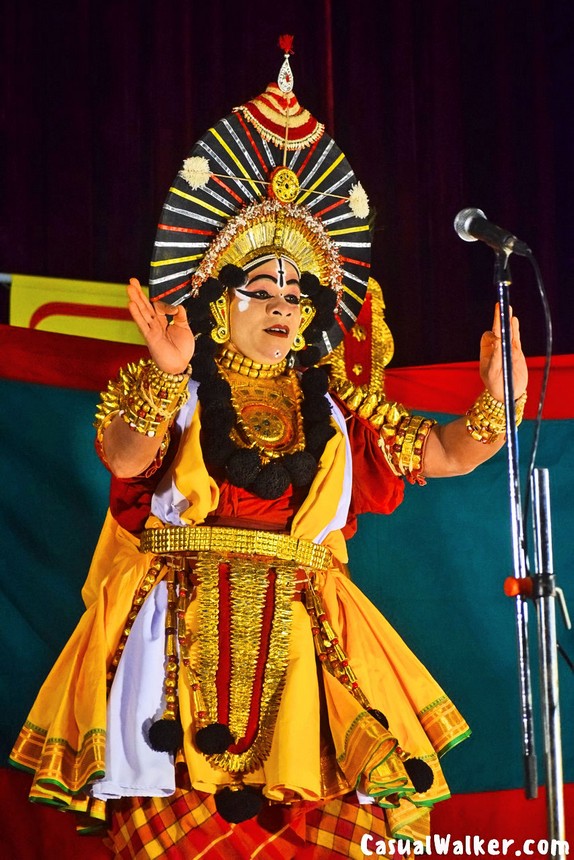
Yakshagana dance uses powerful footwork, spins, jumps, squats and expressive postures. Because the costumes and headgear are heavy, the feet and body carry much of the expression, while the hands stay simpler. Pure dance (Nritta) and expressive dance with meaning (Nritya) blend naturally to awaken Rasa, the emotional essence that connects the audience with the story, whether it is valour, compassion, wonder, love (Shringara) or devotion (Bhakti).
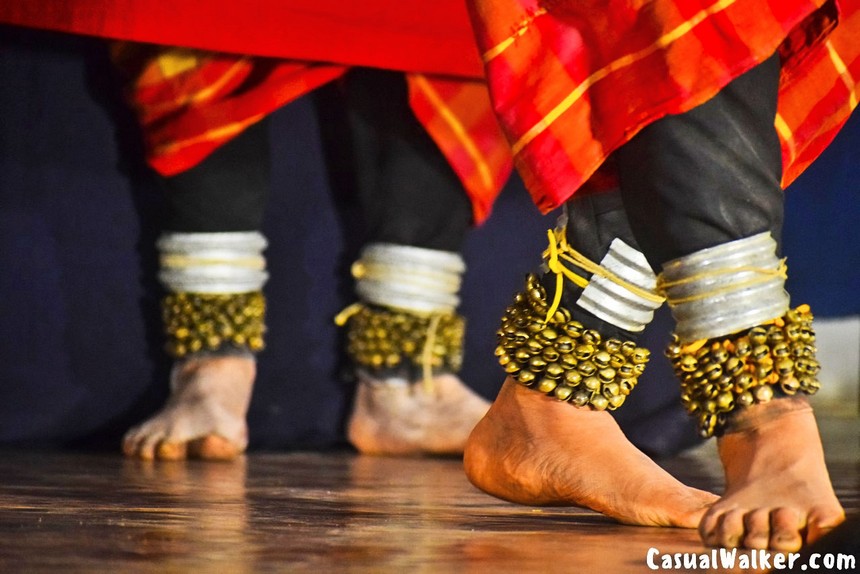
Unlike the strict gestures of Bharatanatyam or Kathakali, Yakshagana uses simple movements, much like everyday gestures. Artists are free to improvise dialogue and expression, and sometimes enter into spirited philosophical debate within the limits of their roles. Dance also changes with the character: heroes are dignified and firm, demons move in slow, broad and measured steps, and female characters are soft and graceful. The clown (Hasyagara) breaks the rules on purpose to bring laughter.
Costumes, Makeup & the Meaning of Colour
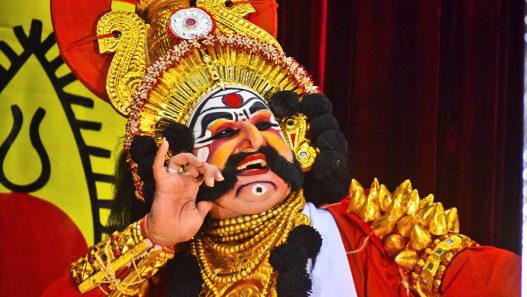
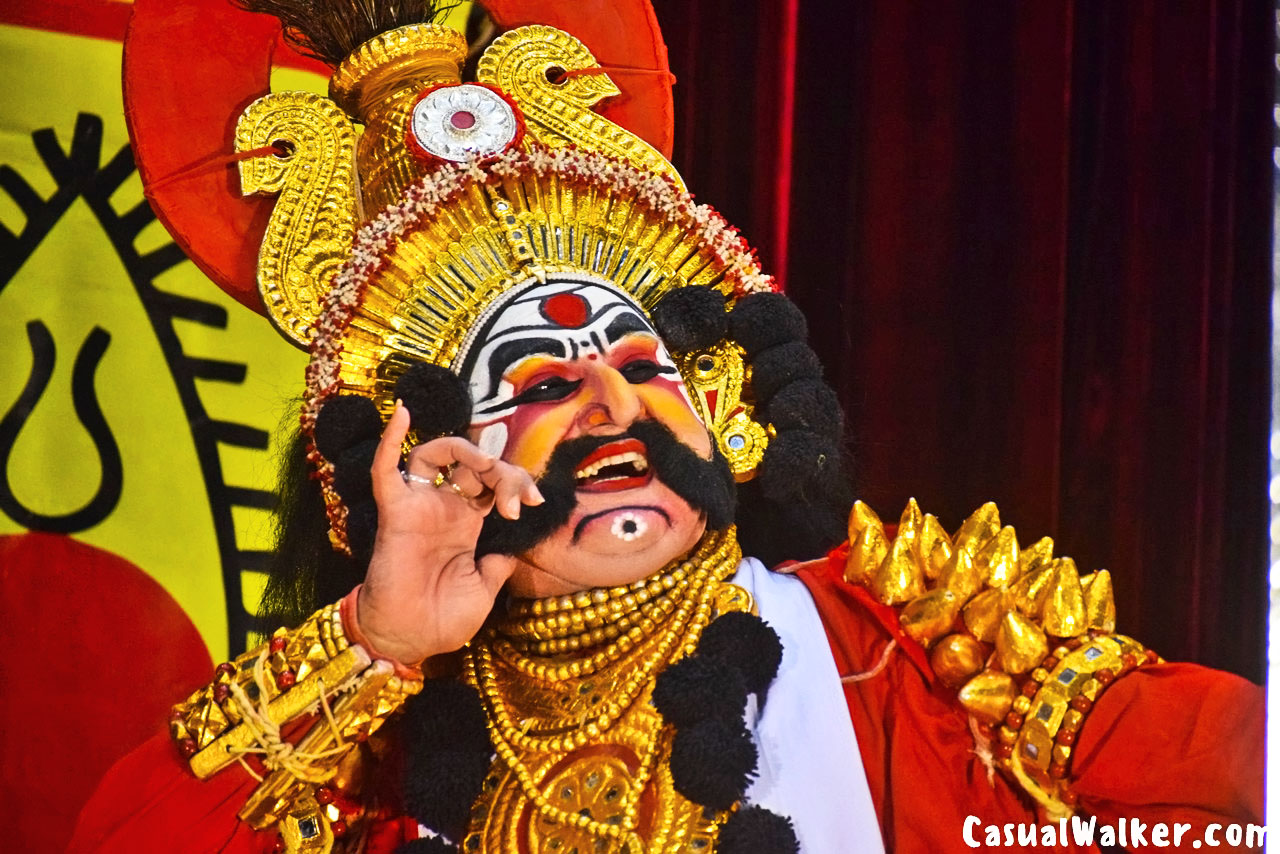
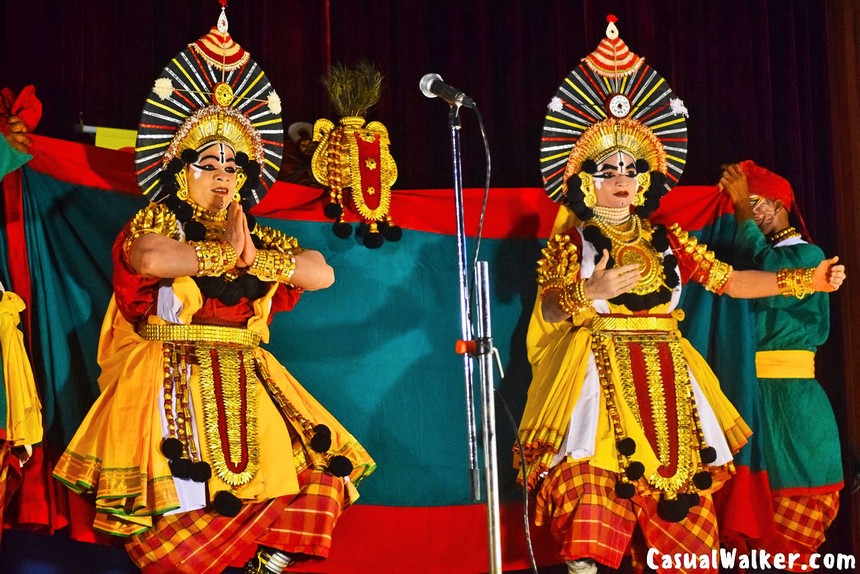
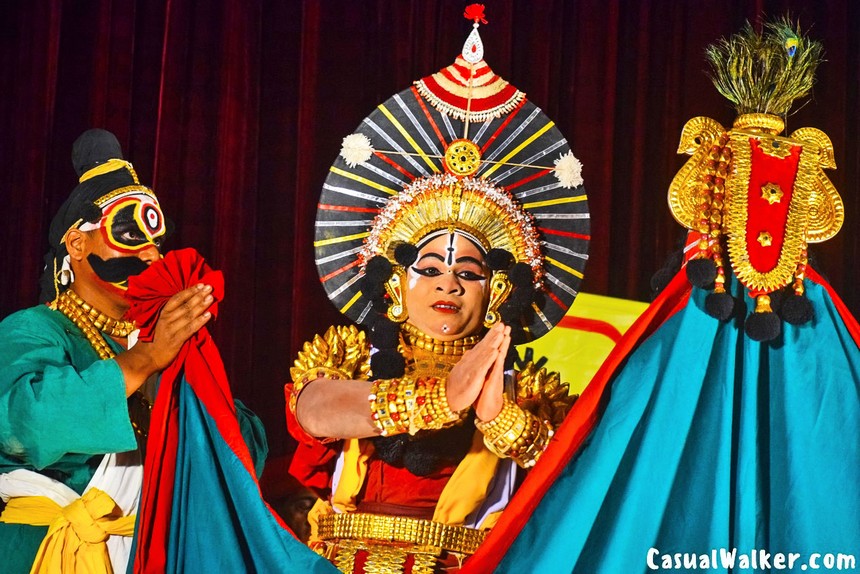
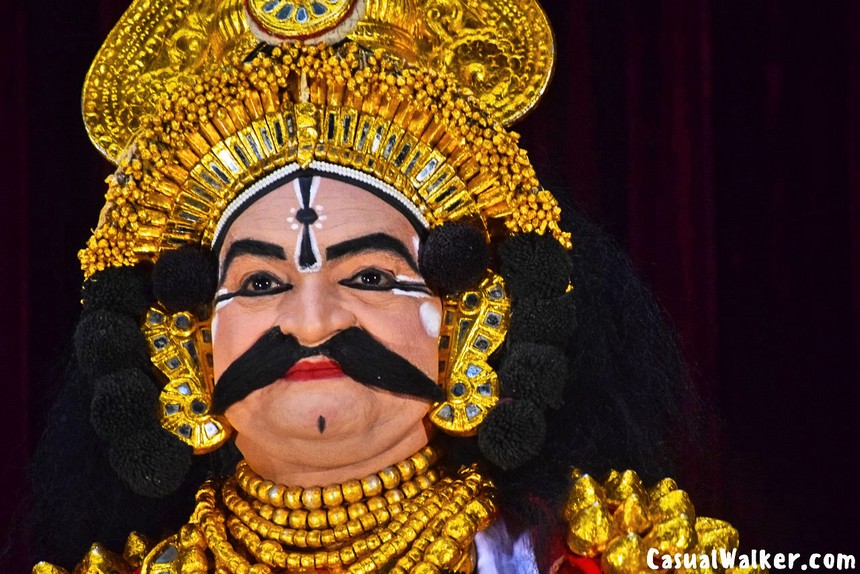
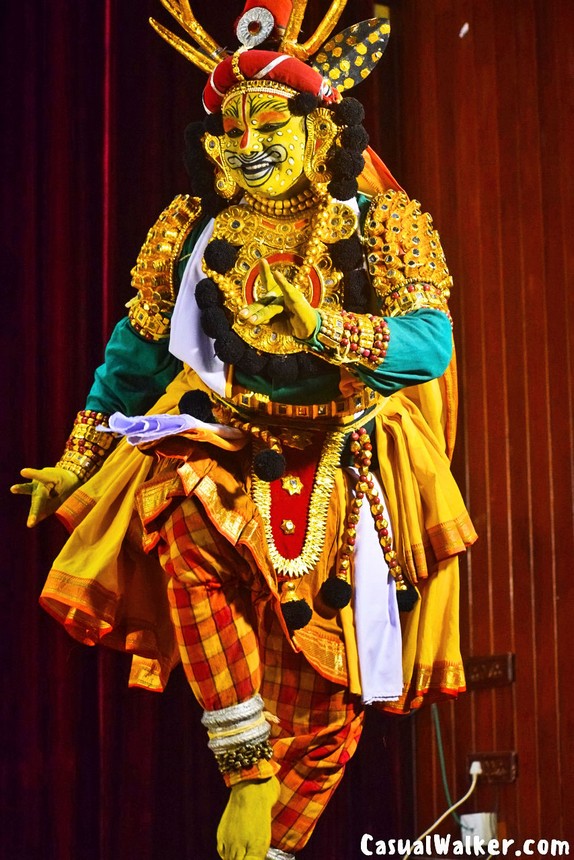
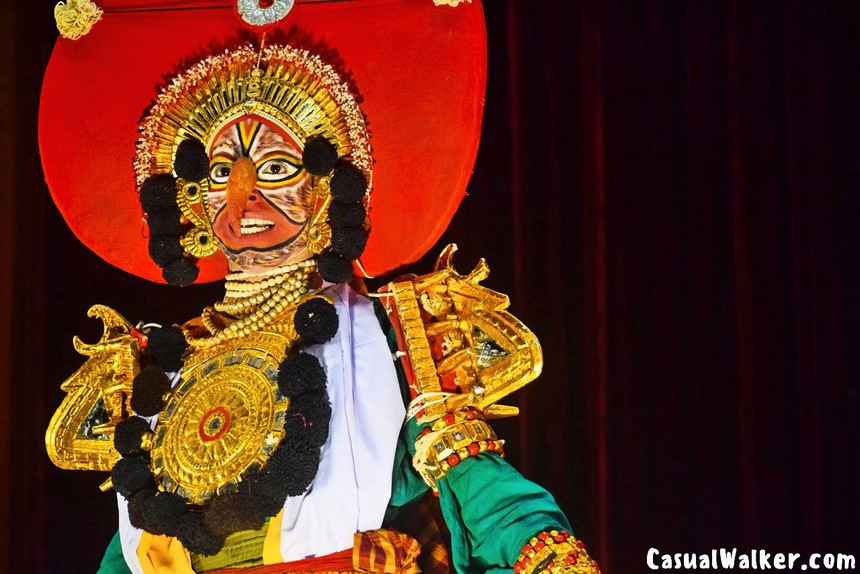
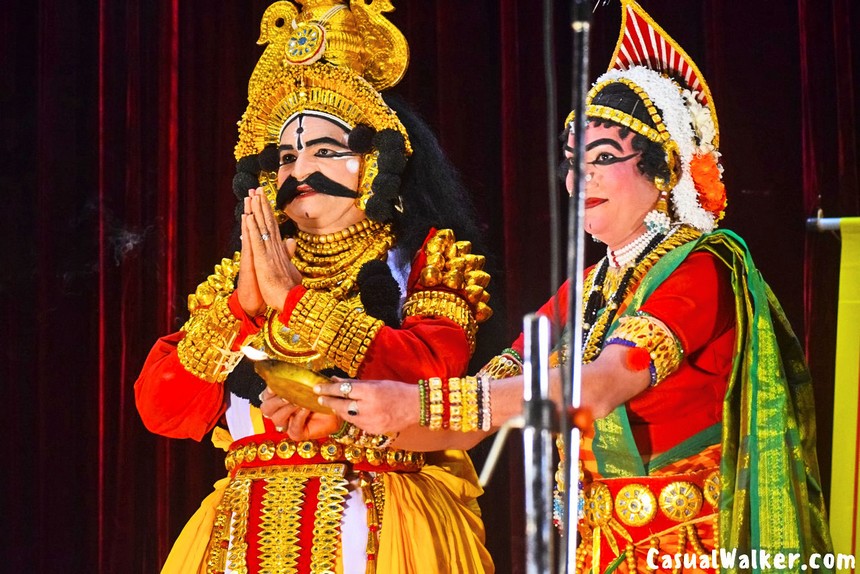
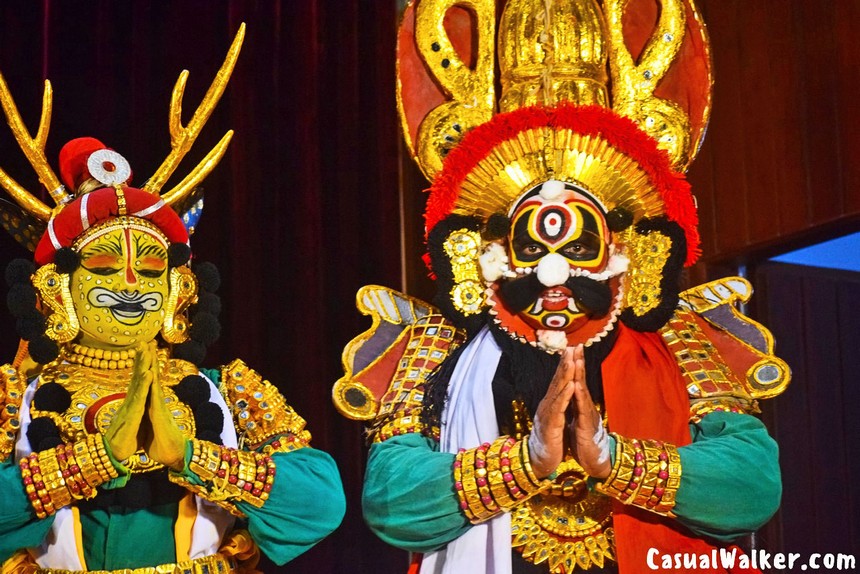
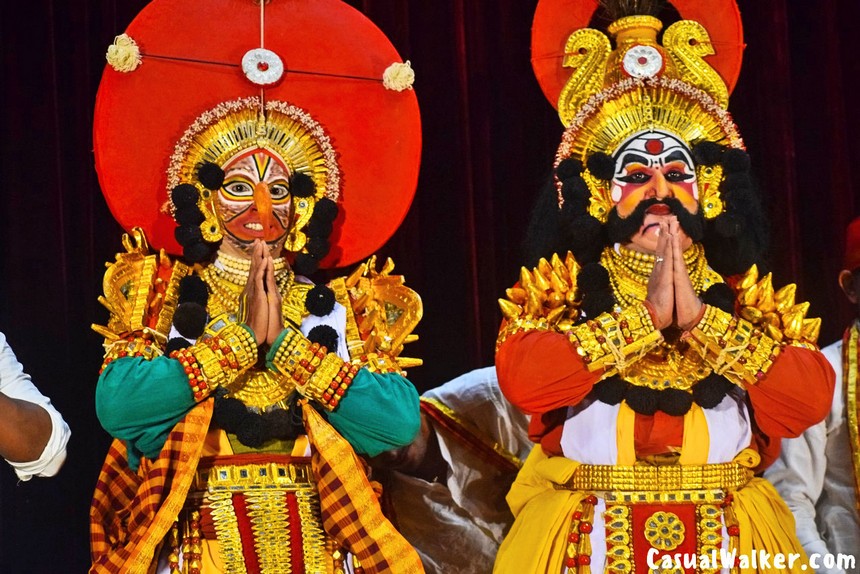
The costumes first catch every traveller’s eye. Large crowns and headgear (kirita or pagade), golden chest plates (kavacha), armlets (bujakeerthi), belts (daabu) and ornaments are made of light wood, decorated with mirrors, coloured stones, pearls and golden foil, and they glitter beautifully in lamplight. Heart shaped headgear belongs to warriors (Pundu Vesha), crowns to kings (Raja Vesha), and towering headdresses to demons (Bannada Vesha).
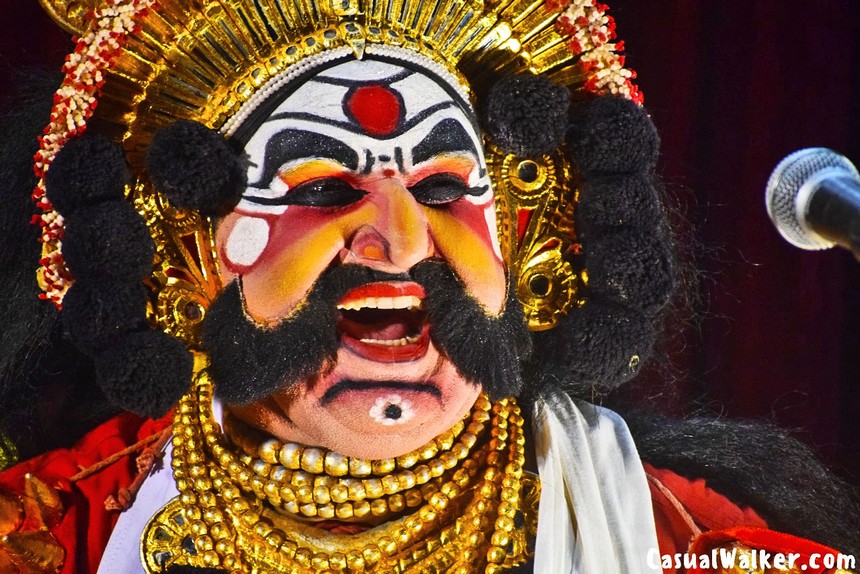
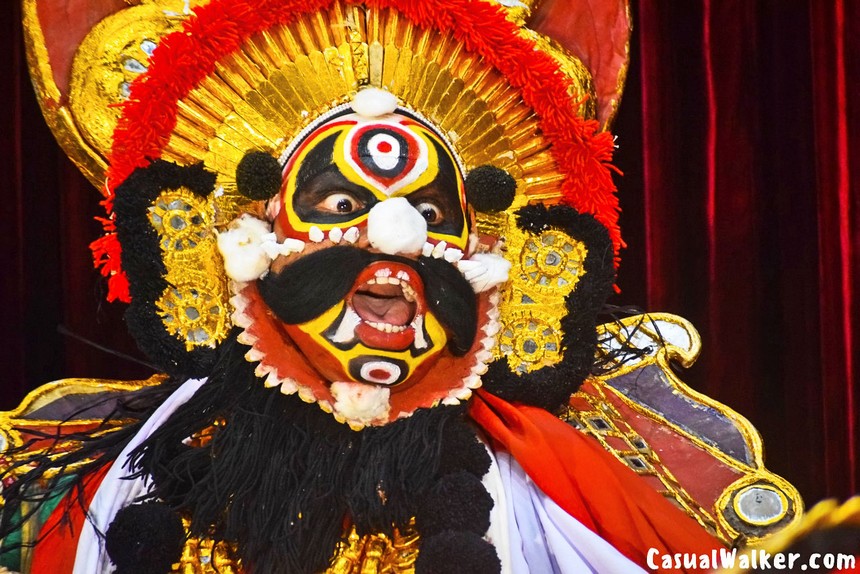
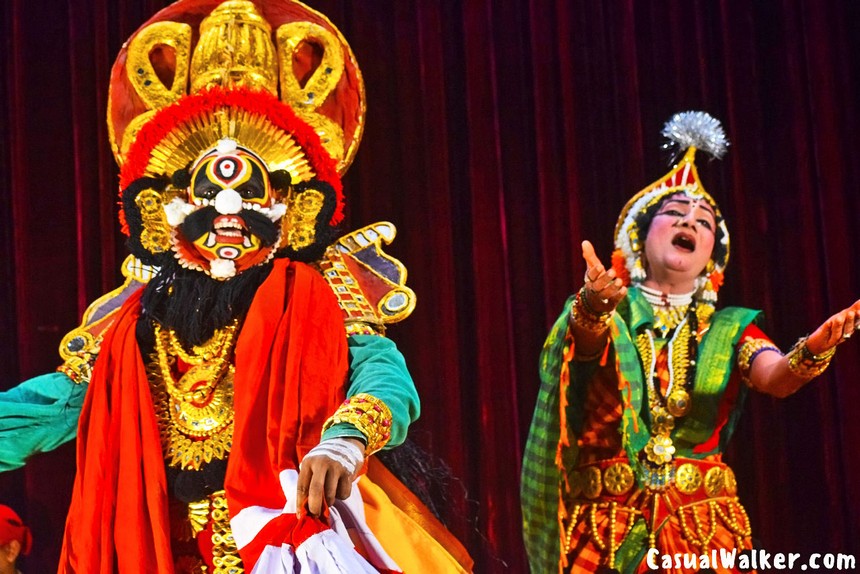
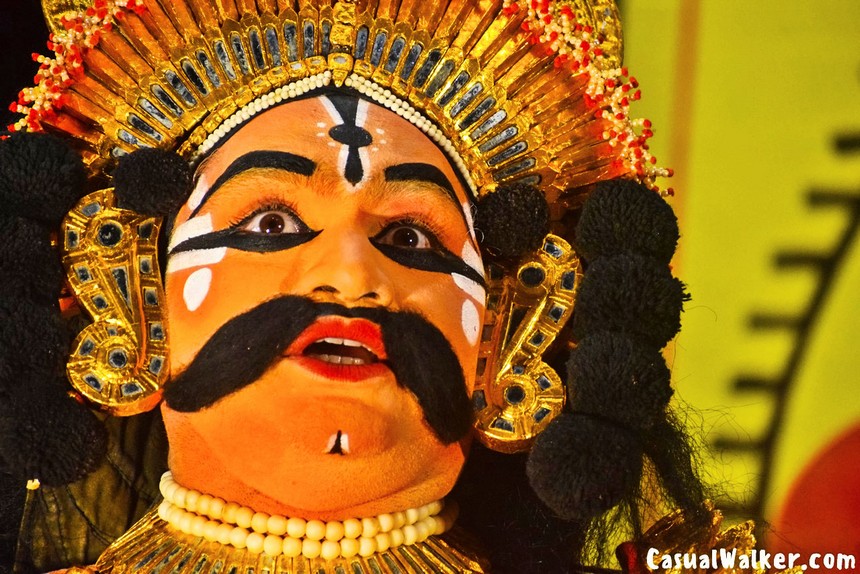
Makeup begins with a base of white zinc and carmine mixed with coconut oil, and demon roles may take up to three hours to complete. Colour tells the audience who the character is: red for heroism and temper, green for peace and beauty, and black for cruelty and darkness. These ideas echo the three qualities of nature, Sattva (purity), Rajas (passion) and Tamas (darkness). Saintly characters belong to the Sattvic world, kings to the Rajasic, and demons such as Ravana and Mahishasura to the Tamasic. In the southern style, three famous colour sets are used: Rajabanna for heroes, Kattubanna for demons, and Streebanna for female roles.
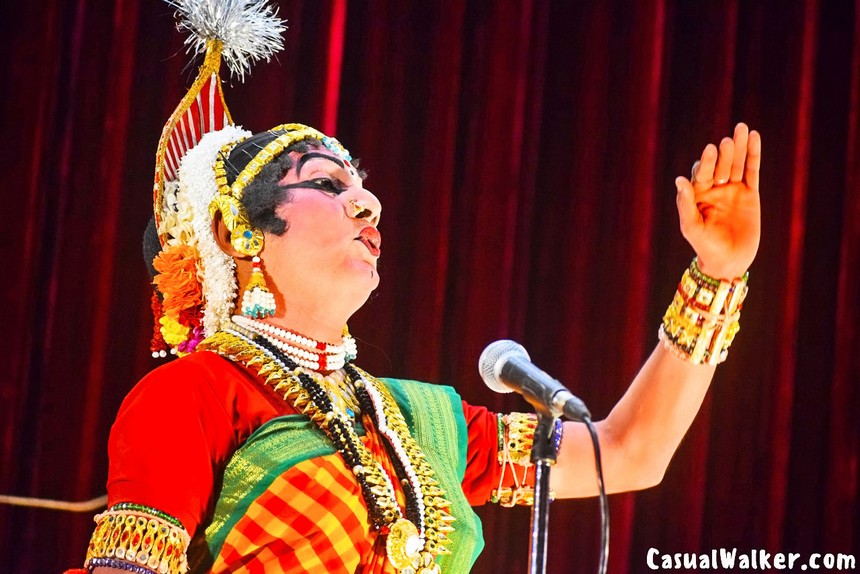
Yakshagana Traditional Performance
A traditional performance runs from dusk to dawn, though shorter shows of three to four hours are now common. The evening begins with the loud beats of the chende, called Abbara or Peetike, which call the audience. In the green room called Chowki, the Bhagavata and his singers stand before the crown of Lord Ganesha, chant invocations, offer coconuts and plantains, and perform a lamp offering (Aarti). After receiving the blessings (Prasada), the troupe goes to the stage.
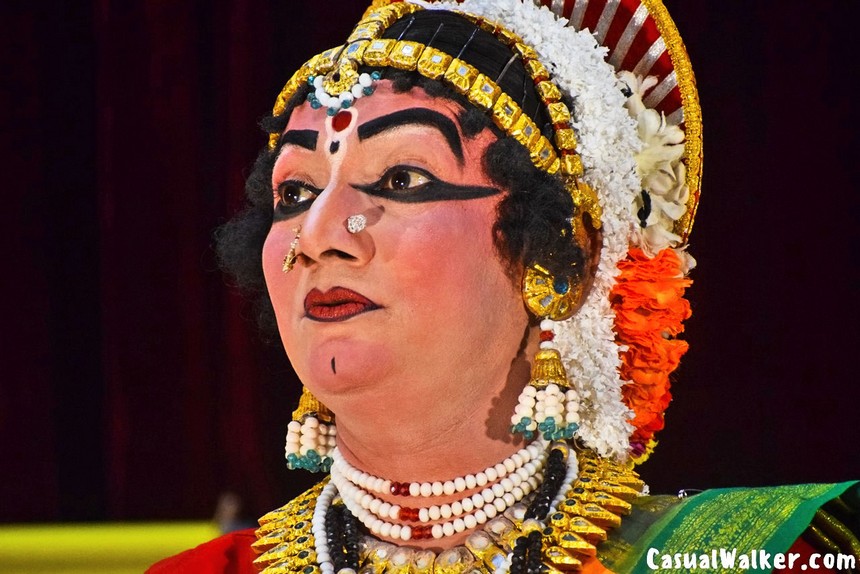
The prologue is the Poorvaranga, where two young dancers appear as the child forms of Lord Krishna and Lord Rama, known as Balagopalas. They honour the guardians of the directions (Dikpalakas) and sing of the ten incarnations (Dashavatara) of Lord Vishnu. Then comes the Oddolaga, the grand court scene, in which kings like Lord Rama, Dharmaraya or Lord Indra are introduced with pomp, praise and dance. Demon characters enter with a fierce roar and a sudden flare of fire, made by throwing resin powder onto a flame.
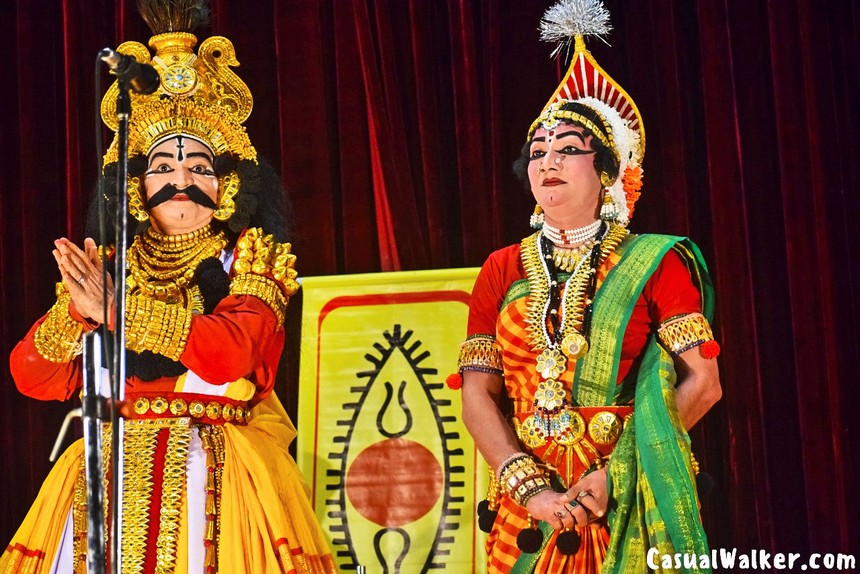
Tere & the Ratha
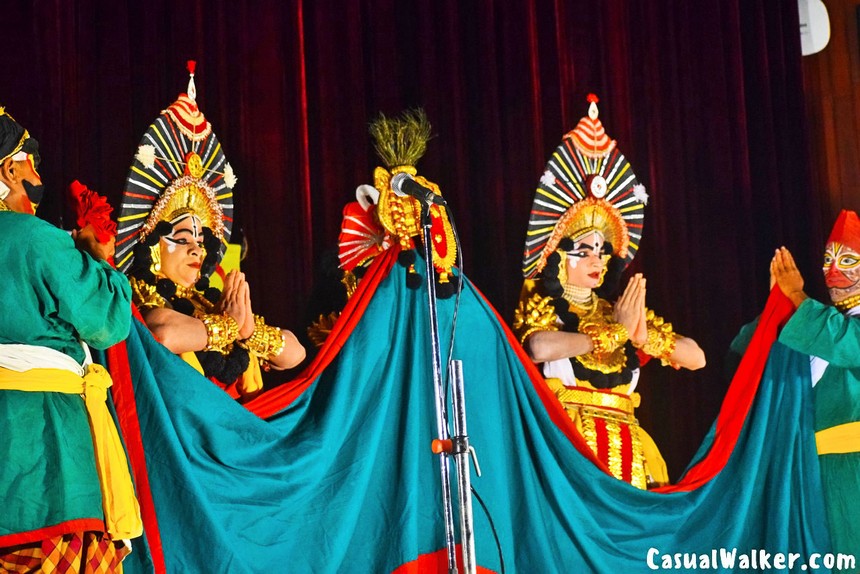
The Tere is a hand held curtain that reveals characters slowly, first the crown and feet, then the face, symbolising the character’s birth into the world of the play. Death is never shown directly. A fallen warrior is quietly hidden behind the Tere and led away.
The Ratha, a simple wooden seat, becomes a throne, a mountain, a chariot, or even the sacred Mount Kailasa when Lord Shiva and Goddess Parvati stand upon it. That is how this theatre turns very little into very much, through imagination and devotion.
Stage Customs
A traditional stage is about twelve feet wide and fifteen feet deep, built in a paddy field or temple yard, with four wooden poles decorated with mango and palm leaves. Spectators sit on three sides, and a raised bench at the back holds the Bhagavata and the maddale player. In older days, the stage was lit by oil lamps and torches, but electric lights and microphones have taken over, adding convenience while removing a little of the old charm.
Keremane Troupe & the Legacy of Dr. Keremane Shivananda Hegde
Every Yakshagana lover along the coast knows the name Keremane. Sri Idagunji Mahaganapati Yakshagana Mandali, often called the Keremane Troupe or the Idagunji Mela, was started by Keremane Shivarama Hegde in 1934 and is named after the revered Lord Ganesha of Idagunji. For a traveller and devotee like me, it feels like a living temple of art, where tradition (Parampara) passes from one generation to the next like a sacred flame.
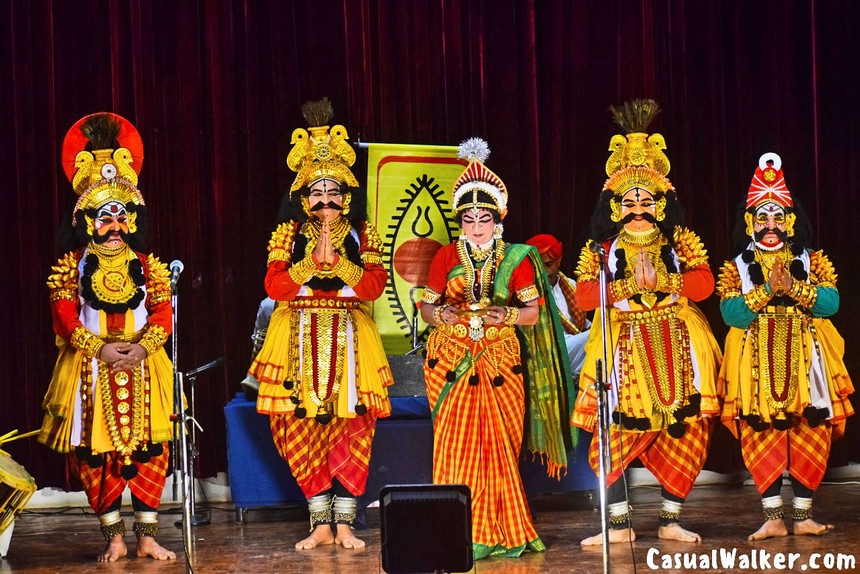
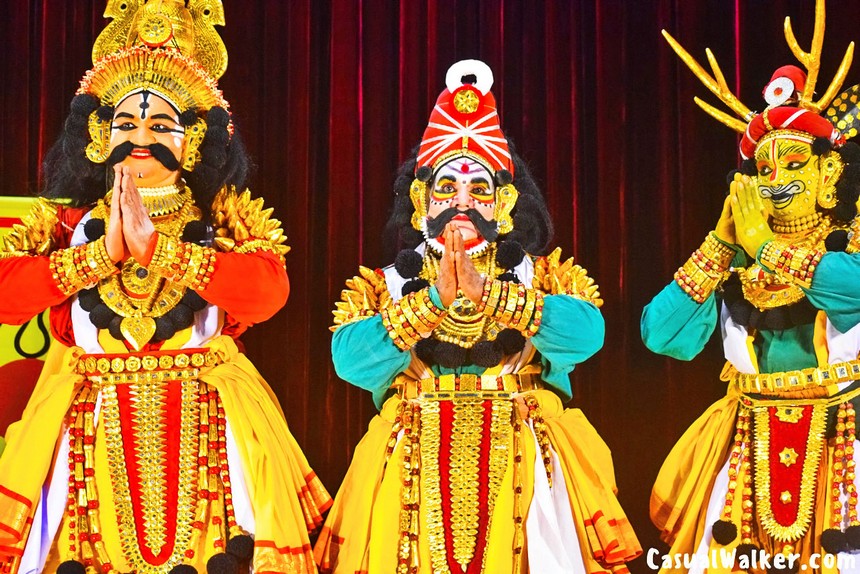
The legacy continued through the founder’s son, Keremane Shambhu Hegde, an iconic artist and reformer who gave the troupe a fresh vision. Today Dr. Keremane Shivananda Hegde, the founder’s grandson, is the director of the troupe and the institution.
He is a performer, director, choreographer and teacher (Guru) who learnt under his grandfather, his father and his guru Dr. Maya Rao. Under his guidance, the troupe has given over 8,000 performances across India and abroad and has been honoured with recognition from UNESCO. In the village of Gunavante near Honnavar, he also runs a Gurukula, a true service (Seva) to the art, so that young hearts will carry Yakshagana into the future.
Seethapahara: The Abduction of Sita on the Yakshagana Stage
Seethapahara, the Abduction of Sita, is one of the most loved and dramatically powerful prasangas of Yakshagana. Drawn from the Ramayana, it shows how Ravana, the proud king of Lanka, plans to take Goddess Sita from the forest of Panchavati. Every devotee knows the story by heart, yet in the hands of the Keremane artists it feels brand new.
Court of Ravana and the Seed of Revenge
The prasanga opens with the grand Oddolaga. A stirring roar is heard from behind the Tere, and the audience waits with held breath. Slowly the crown rises, then the fierce painted face, and Ravana stands revealed in black and red, with a towering headdress and a booming laugh.
Then comes the news of his sister Shurpanakha, wounded and humiliated in the forest of Panchavati. She speaks of a matchless beauty who lives there with two princes. Ravana’s pride burns, and the seed of Adharma is sown. This scene is rich with Raudra Rasa (fierce emotion), and the chende drum rolls like distant thunder.
Ravana Meets Maricha
Ravana now seeks the help of his uncle Maricha, who lives as a sage in the forest. Maricha has already felt the arrow of Lord Rama in the past, and he pleads with Ravana to turn back. He speaks of Dharma and warns that this path will end in ruin. The Bhagavata sings these lines with a sorrowful, rising melody, and the dialogue between the two becomes a fine battle of words. Ravana’s anger grows, and Maricha agrees at last, with sadness on his face that tells us he knows his fate.
Golden Deer of Panchavati
The mood changes completely as the peaceful cottage of Lord Rama, Goddess Sita and Lord Lakshmana comes to life. Then the golden deer sent by Maricha appears, leaping and prancing with shining charm. The dancer’s quick footwork and playful spins make the audience smile. Goddess Sita is enchanted and asks Lord Rama to fetch it for her. Lord Lakshmana senses danger and calls it a trick of the demons, but Lord Rama, out of love and the duty of a husband, agrees to go. This is the moment where fate turns, and the audience feels a shiver pass through them.
False Cry and the Sacred Line
Far in the forest, Lord Rama’s arrow strikes the deer, and Maricha shows his true form. With his last breath, he cries out in the voice of Lord Rama, calling for Sita and Lakshmana. The Bhagavata’s voice rises sharply and the maddale beats a hurried rhythm.
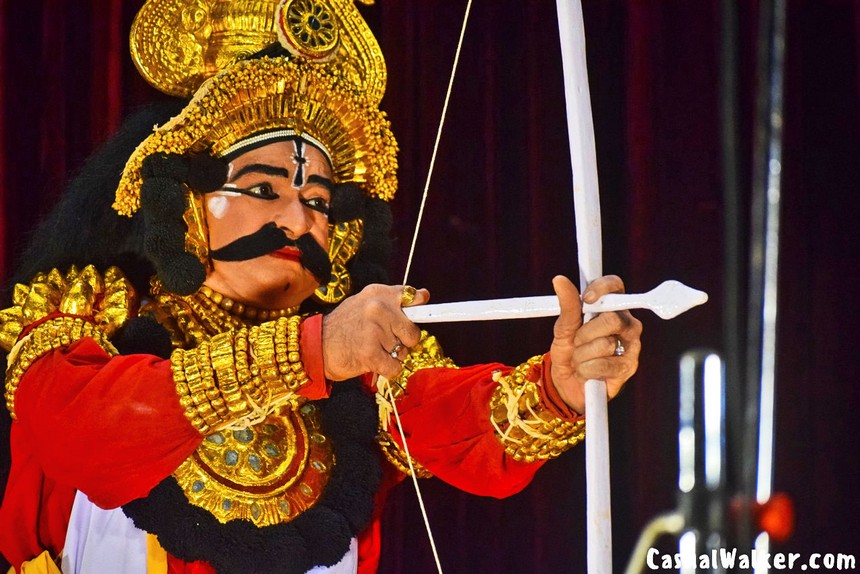
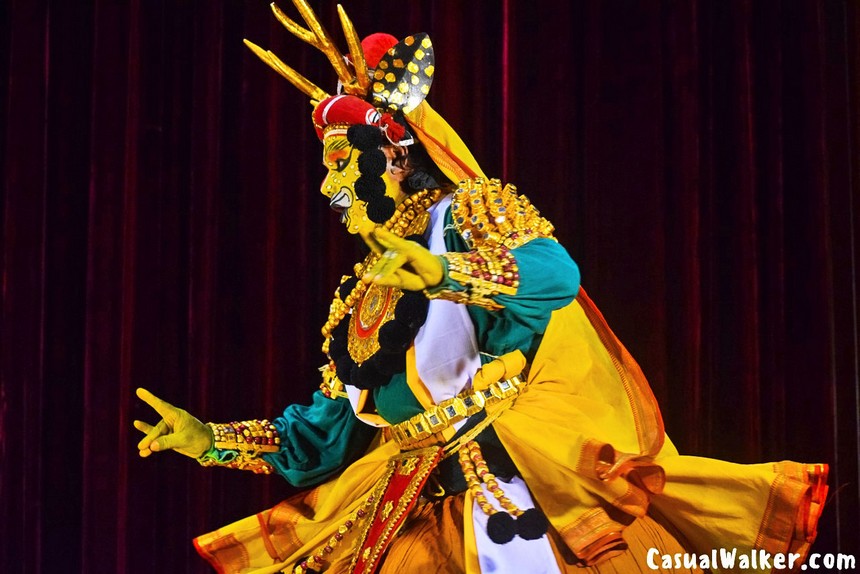
Goddess Sita trembles and begs Lord Lakshmana to run to his brother’s aid. When he hesitates, her grief turns into sharp words that wound him deeply. With great pain, Lord Lakshmana draws the sacred line, the Lakshmana Rekha, around the cottage, tells her never to cross it, and departs. The silence on stage after he leaves is full of Karuna Rasa (compassion).
Ravana as the Wandering Ascetic
Now Ravana enters in the humble guise of a holy man (Sanyasi), with a staff and saffron robes. The proud king bends his back, softens his voice and speaks sweet words, yet his eyes still gleam with hidden danger. The music turns gentle and the rhythm slows, as if the whole night is holding its breath.
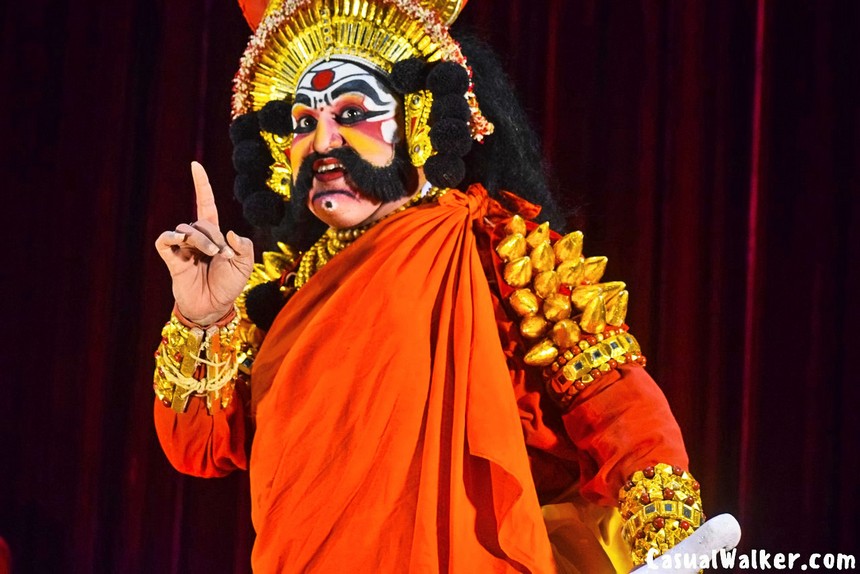
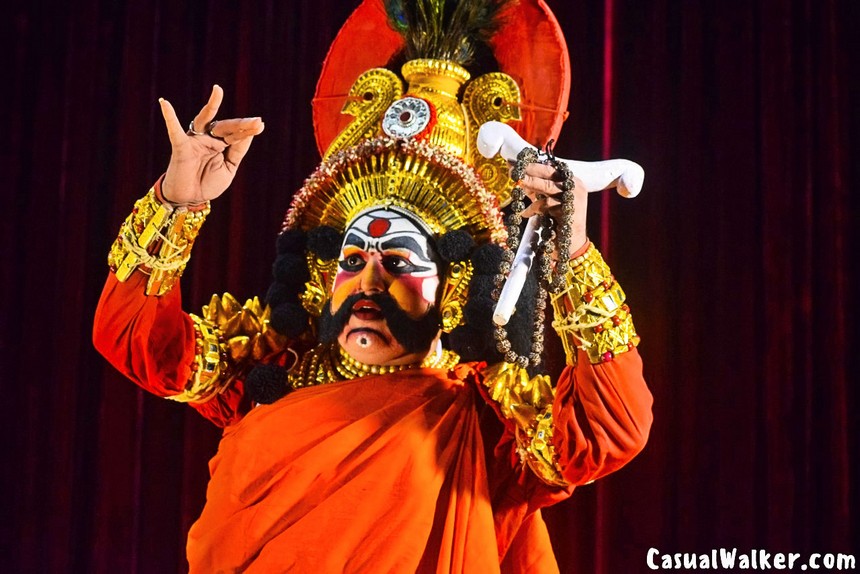
He asks for alms (Bhiksha), and Goddess Sita, true to her gracious nature, wishes to honour the guest. In the end she steps across the line. The moment is told with the slightest movement of the foot, and the audience feels it in the heart. Her goodness becomes the very door that Adharma uses to enter.
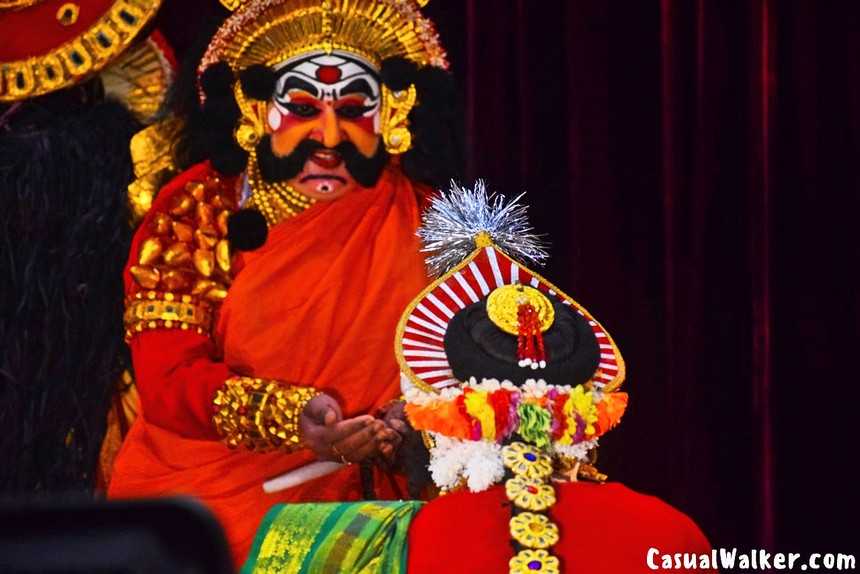
True Form and the Flight Through the Sky
The ascetic’s mask falls, and Ravana reveals his terrible form with a thunderous roar. The chende bursts into a fierce storm of sound, and Goddess Sita cries out for Lord Rama and Lord Lakshmana, her cries going through the night like a prayer. Ravana lifts her and flies across the sky. The humble wooden Ratha becomes the aerial chariot, and the swirling movements of the dancers, together with the rhythm of the drums, create the feeling of flight.
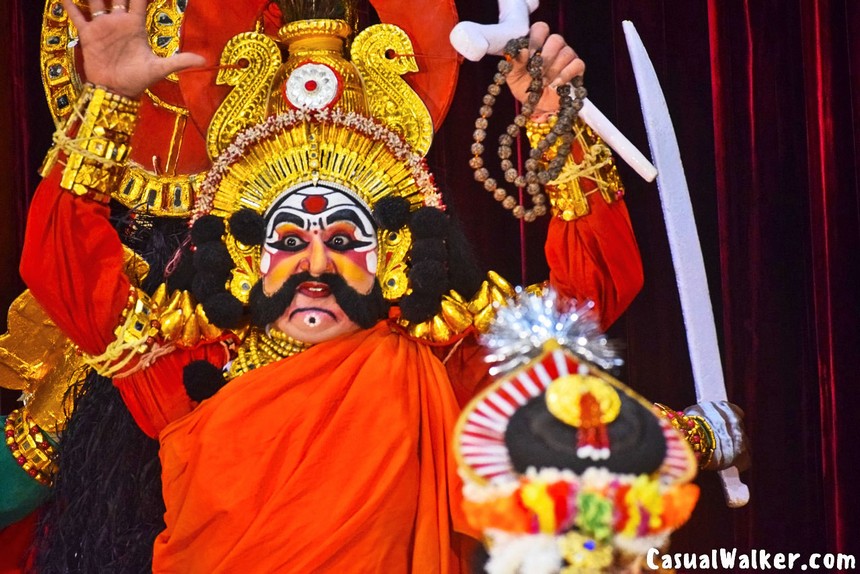
Brave Fight of Jatayu
Then the great bird Jatayu, the old friend of the family of Lord Rama, hears her cry. He appears with wide spread arms, strong leaps and fierce, noble energy, and he challenges Ravana to a fight. The stage fills with Veera Rasa (valour), and the battle is shown with powerful footwork and bold diagonal steps. Though old in age, his courage is young. In the end Ravana cuts his wings, and Jatayu falls.
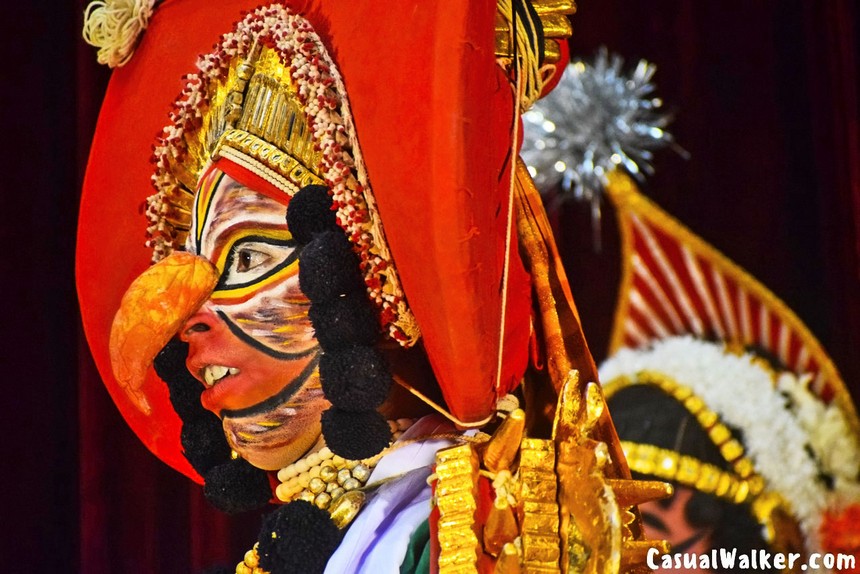
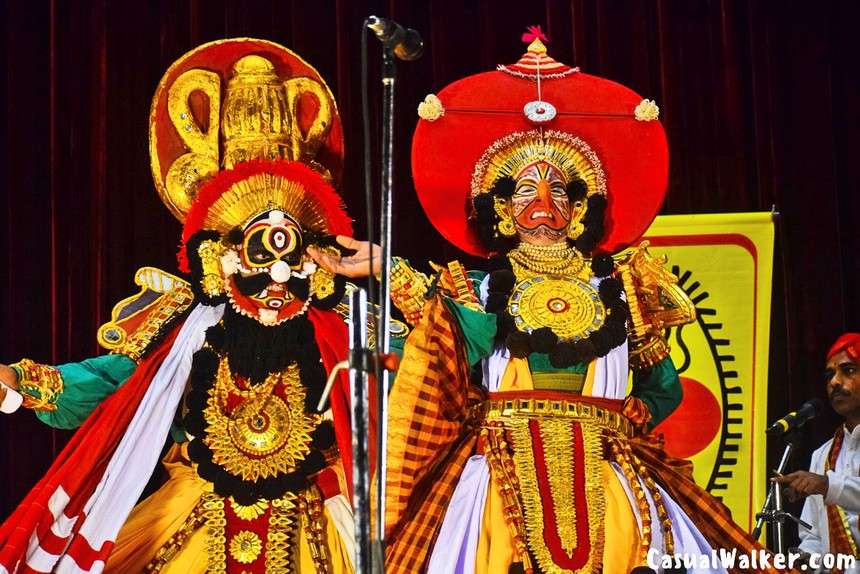
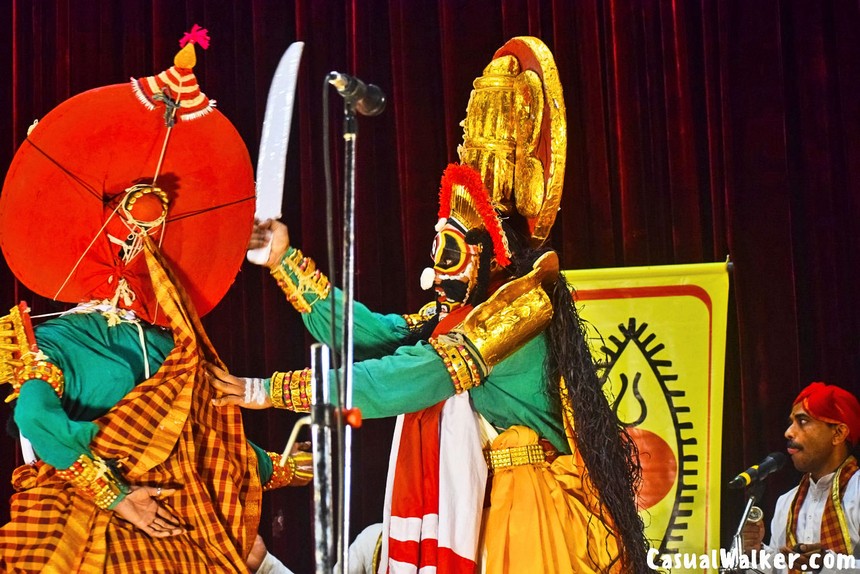
As is the custom, the fall is not shown in a violent way. The Tere gently hides the fallen hero, and the moment becomes quiet and deeply moving. Jatayu waits for Lord Rama, to tell him the news and to receive his final blessing, a moment many devotees see as a path to liberation (Moksha).
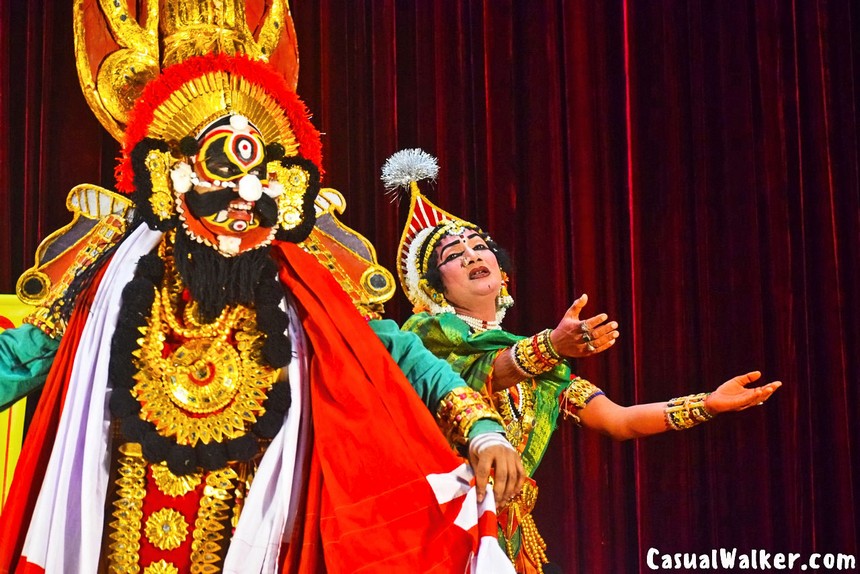
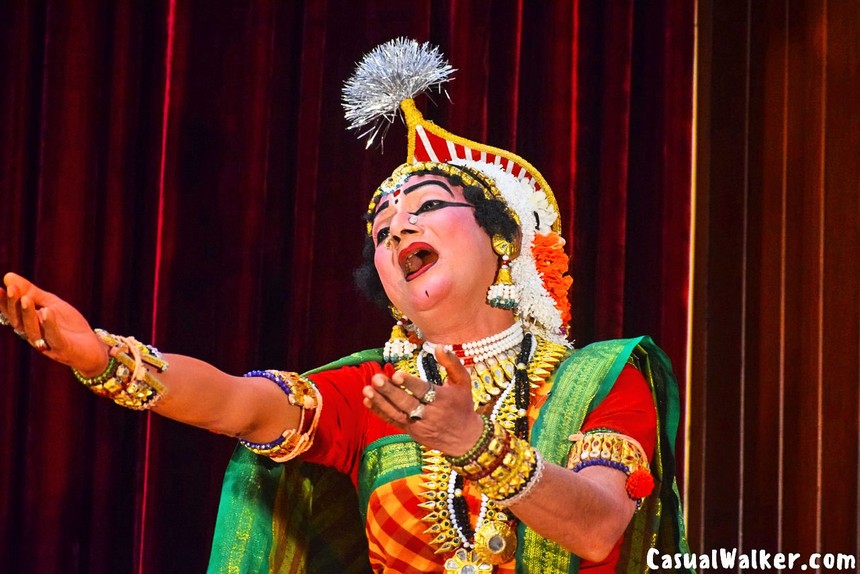
Great Performance of the Keremane Troupe
What makes the Keremane performance so memorable is the way every part of the stage works as one. With over eight thousand performances across India and abroad, the long experience of the troupe shows in every moment. The entrances are timed to the beat, the pauses are held with confidence, and the artists listen to one another like a single family of devotees. Under the guidance of Dr. Keremane Shivananda Hegde, the old traditions of the Oddolaga, the Tere and the Ratha are kept alive with respect, while the staging stays clear and welcoming for new audiences.

Travel Tips & Best places to Watch Yakshagana in Karnataka
Best Season and Months to Watch Yakshagana
The best season to watch Yakshagana is from November to May. After the monsoon ends and Diwali is celebrated, the professional troupes (Melas) set out on their annual tour, and village and temple festivals (Jatre) fill the coast with lamps, drums and devotion.
The season begins and ends by seeking the blessings of the deity of the temple that the troupe belongs to. It closes around May with a ceremony called Pattanaje, held on the tenth day of the solar month of Besa, just before the rains return in June. During the monsoon months, the main touring season rests, and smaller troupes called Chikkamela keep the art alive in the off season. So plan your visit between late November and April, when you have the best chance of finding a show almost every night.
Famous Temple Troupes: Kateel, Mandarthi & Dharmasthala
For a sacred experience, begin at the great temple troupes of coastal Karnataka. The Sri Durgaparameshwari Temple at Kateel, about 20 kilometres from Mangaluru, stands on an island formed by the River Nandini. It has six touring troupes, and devotees who see their wishes fulfilled offer a Yakshagana performance to the Goddess as a vow (Harake Seva).
The wait to book one can be many years, so for travellers the easier option is to watch the troupes perform near the temple premises during the season. Another beautiful stop is the Sri Durgaparameshwari Temple at Mandarthi near Brahmavara in Udupi district, where performances are held almost every day during the season. At Dharmasthala, the Sri Kshetra Dharmasthala Manjunatha Swamy Temple has its own troupe, the Dharmasthala Mela, and it is a rewarding place to see stories of Goddess Devi, the Ramayana and the Mahabharata. The Saligrama and Perdoor troupes are also well known, and they perform across the coast through the season.
Top Towns & Regions: Udupi, Mangaluru, Sirsi & Kasaragod
Among the towns, Udupi, Mangaluru, Kundapura, Karkala, Sirsi and Kasaragod are the best places to begin, since many shows, temple festivals and cultural events are held in and around them. In Udupi, the Yakshagana Kendra also presents regular performances by its students and artists.
The famous Udupi Sri Krishna Matha, connected with the early Dashavatara traditions of Narahari Tirtha, adds a spiritual layer to the journey. In Sirsi and the Uttara Kannada region, you can find the Badagutittu style, with its fine facial expression and dialogue. Around Mangaluru, Puttur, Sullia and Karkala, the Tenkutittu style shines with its bold colours and dramatic presence.
Meet the Keremane Troupe at Gunavante & Idagunji
For anyone who wishes to meet the Keremane Troupe, the Keremane region near Honnavar in Uttara Kannada is a rewarding stop. The troupe, Sri Idagunji Mahaganapati Yakshagana Mandali, is based at Gunavante village in Honnavar taluk, and it is named after the revered Lord Ganesha of Idagunji. The temple of Lord Ganesha at Idagunji is only a short journey away, so devotees can combine a darshan of the Lord with a Yakshagana evening. A visit to the village, and to the Gurukula where students train, shows how the art is passed from teacher to student (Guru Shishya Parampara).
Practical Travel Tips for Watching Yakshagana
A few practical tips will help your journey. Shows usually begin after dusk, and the traditional all night performance runs until dawn, though shorter versions of three to four hours are also common. Dates and venues change every year, since temple festivals follow the Hindu calendar, so ask at the temple office, check local news, or ask the local people a few days before. Wear light clothes, carry a shawl for the cool nights, and arrive early to see the makeup and costume preparation in the green room (Chowki).

Thanks for exploring this Casual Walker photo guide — India’s most visual cultural travel guide and a curious discovery journal finding authentic photo stories, guides, and tips across travel, culture, arts, temples, heritage, and food.
- Keep exploring: Browse 650+ Travel & Culture Photo Guides
- We’d love to hear your feedback, stories, corrections, and updates — Email us.
- Follow our photo walks on Instagram: @hicasualwalker