



Mylapore Kolam Festival 2026 : Largest Monochrome Kolam & Colored Rangoli Contest at North Mada Street | Types of Kolam : Dot-Based Pulli Kolam, Interlocking Chikku Kolam, Rope-Pattern Kambi Kolam & Freehand Neli Kolam Street Art in Sundaram Finance Mylapore Festival Margazhi Month Cultural Celebration | Traditional South Indian Geometric Ritual Art & Tamil Culture Complete Travel Guide (Updated)
– explore the mylapore’s most iconic traditional kolam festival

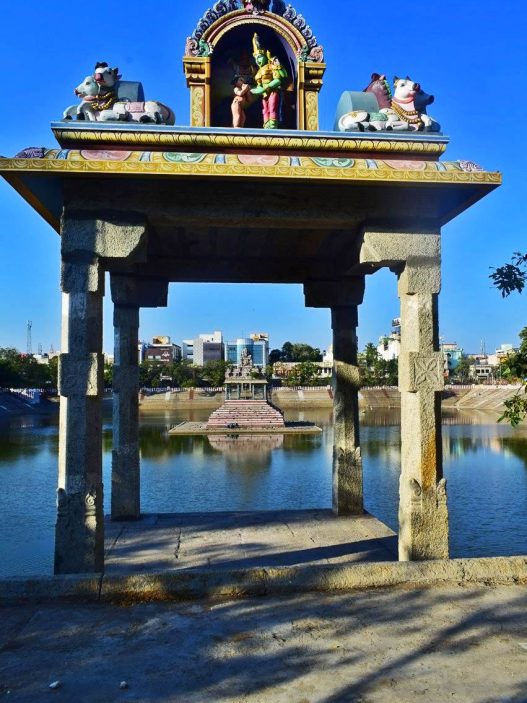
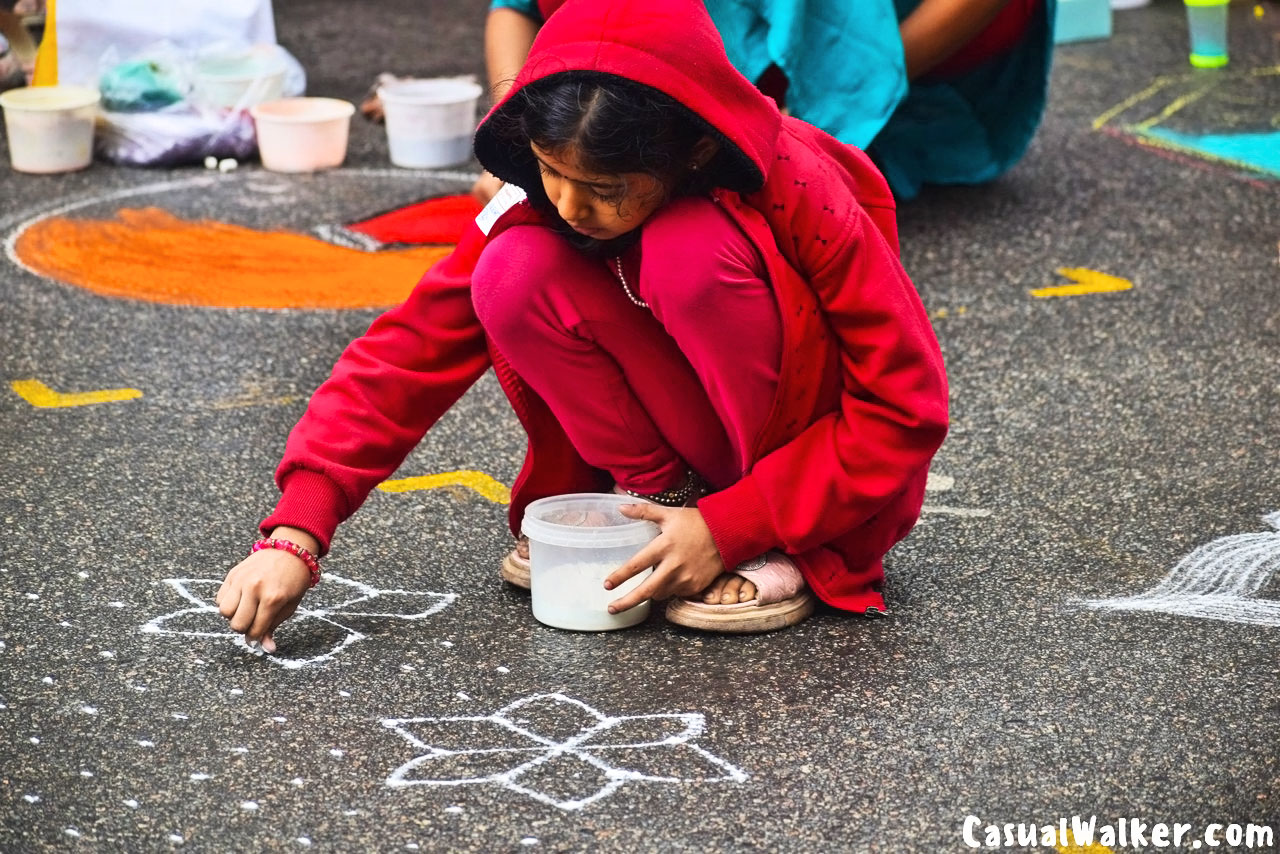
The 22nd edition of the Sundaram Finance Mylapore Festival 2026 is more than just a cultural event, it’s a four-day spiritual and artistic pilgrimage that transforms Chennai’s oldest neighborhood – Mylapore into a living, breathing celebration of Tamil heritage. Set against the magnificent backdrop of the ancient Kapaleeswarar Temple, this festival recreates the magical “Thiruvizha” atmosphere that once defined Tamil culture during the sacred Margazhi month. 
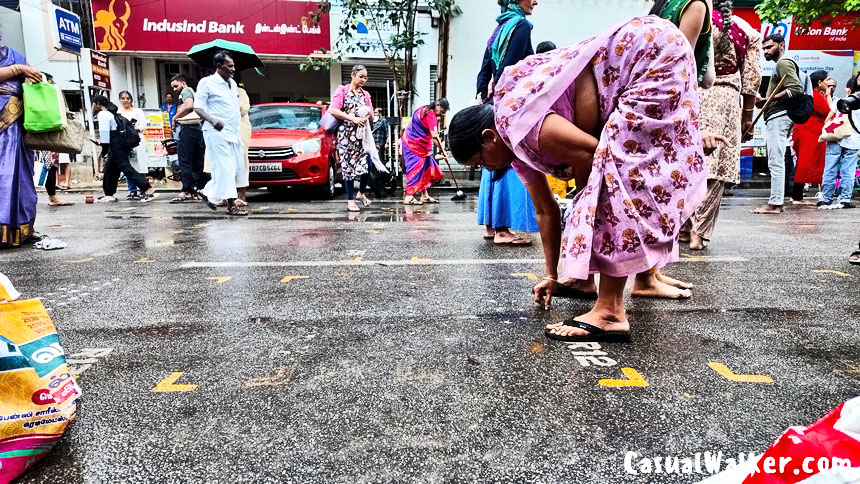
The world-renowned Kolam Festival draws artists and art lovers from across the globe. This isn’t merely a festival; it’s where spirituality meets creativity, where ancient traditions dialogue with contemporary expressions, and where the entire community—from children to grandparents, locals to international visitors—comes together to celebrate the artistic soul of South India.
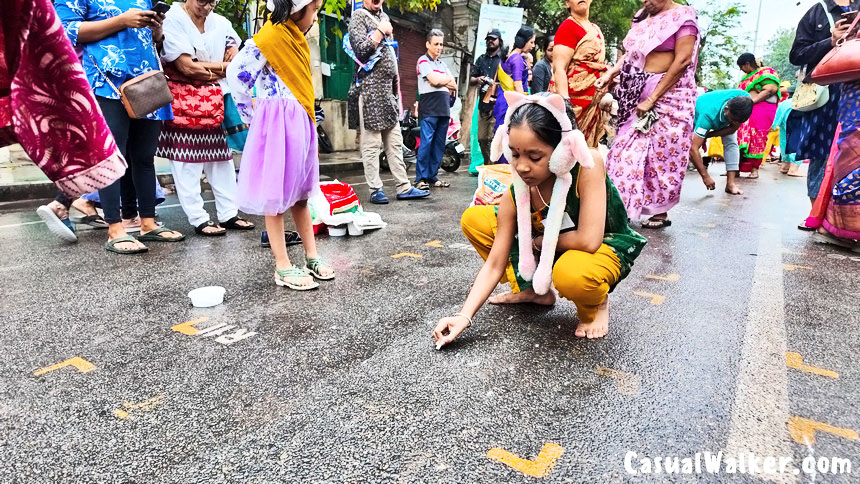
The evening air carried a gentle mist as I arrived at North Mada Street, a light drizzle had been sprinkling down earlier, and I’d worried it might dampen the Sundaram Finance Mylapore Festival‘s legendary Kolam Festival. But as if the gods themselves blessed this artistic gathering, the rain stopped just as the event was about to begin. The street glistened from the brief shower, the wet asphalt creating a perfect dark canvas that would make the white kolam powder and vibrant rangoli colors stand out even more dramatically.
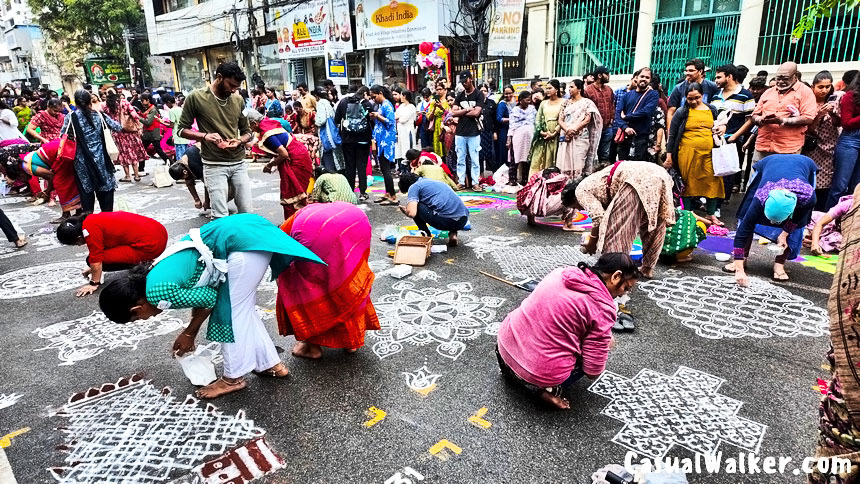
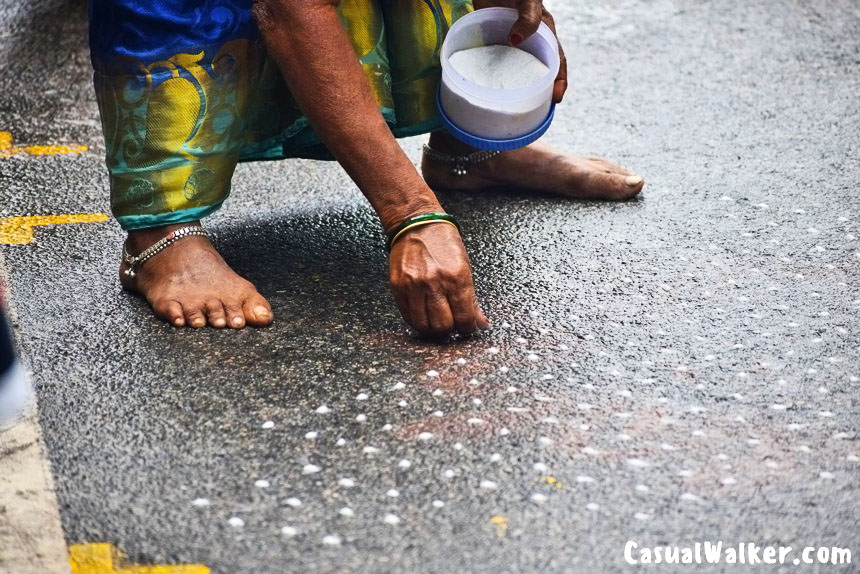
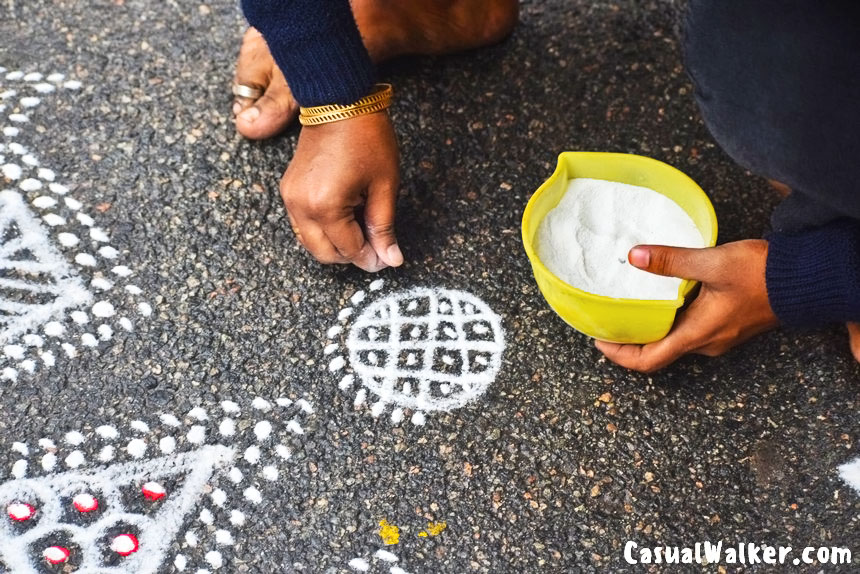
Magic Unfolds: When Streets Become Sacred Galleries
The timing couldn’t have been more poetic—the evening light softened by the passing rain clouds, and North Mada Street in Mylapore buzzing with hundreds gathering for what would become one of the most visually intoxicating cultural experiences of my life.
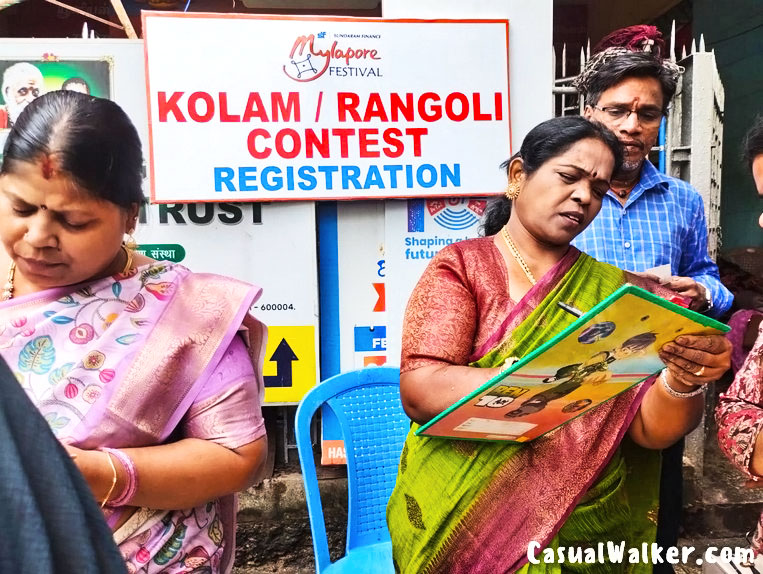
What struck me most was how the earlier drizzle hadn’t deterred anyone if anything, it seemed to intensify the enthusiasm. I witnessed a massive queue of people patiently waiting to register for the Kolam Festival, snaking along the street despite the lingering dampness in the air. The registration area buzzed with energy as participants eagerly collected their tokens and slot assignments, their faces lighting up when they learned which designated square on the open road would become their canvas. The sheer number of people—hundreds upon hundreds—willing to wait in line, rain or shine, spoke volumes about the deep cultural significance and personal importance of this tradition.
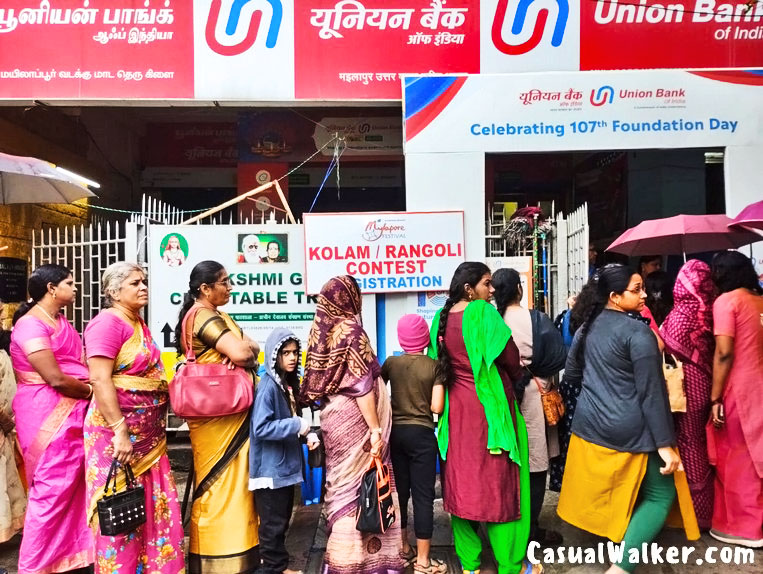
As the last drops of rain faded away and participants received their tokens, hundreds of people—toddlers clutching their parents’ hands, confident teenagers, middle-aged men and women, elderly grandmothers, and even enthusiastic foreigners—descended upon their designated spots, armed with kolam powder, rangoli colors, and centuries of inherited artistry.
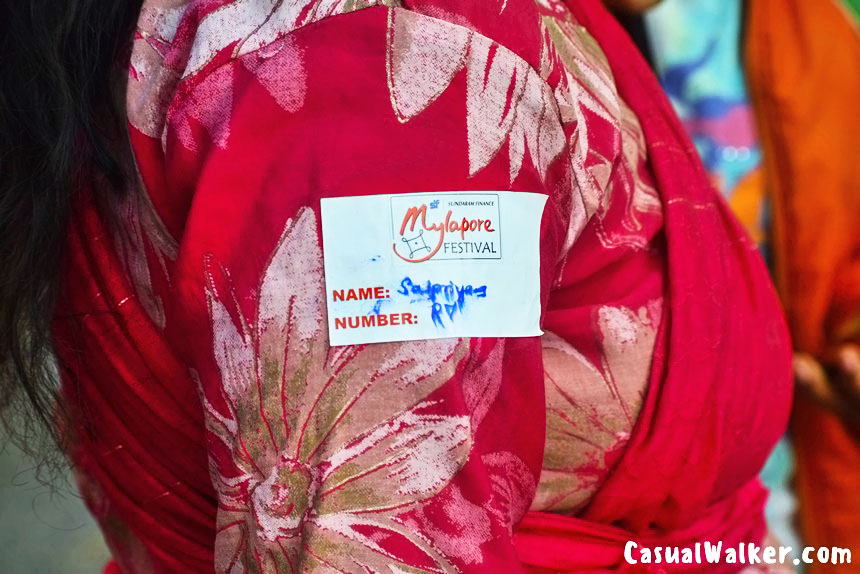
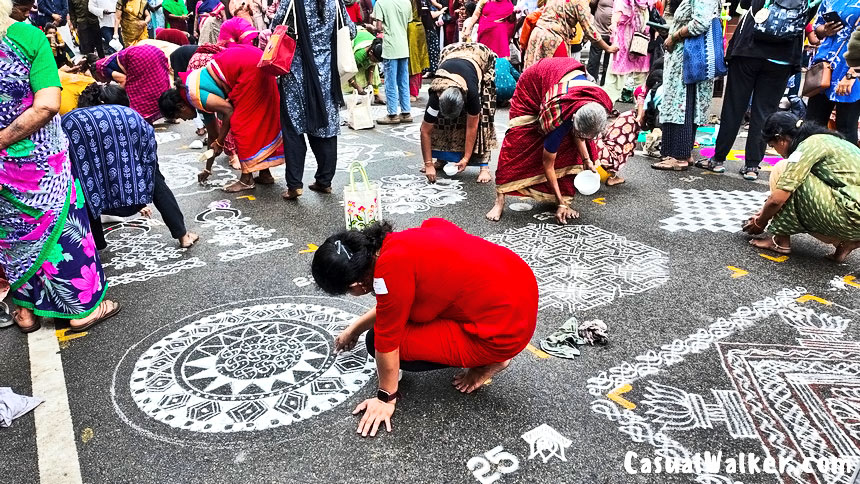
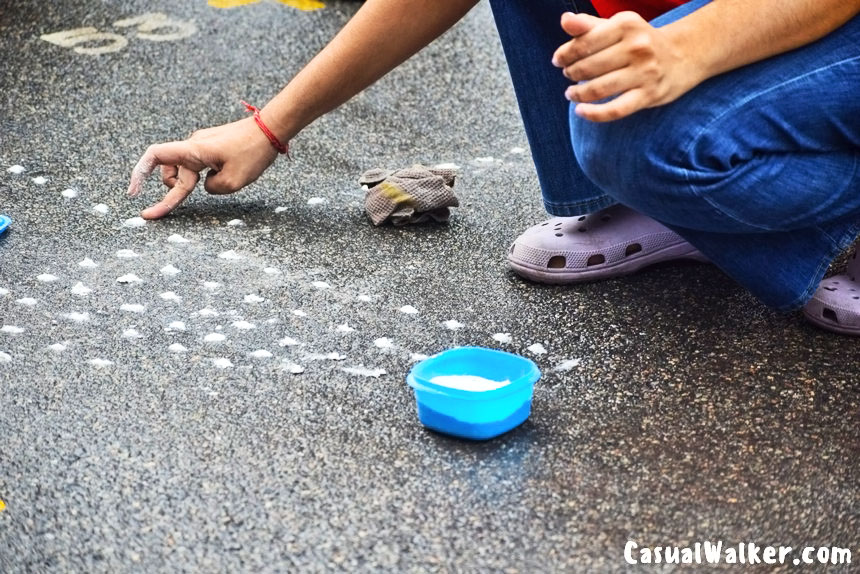
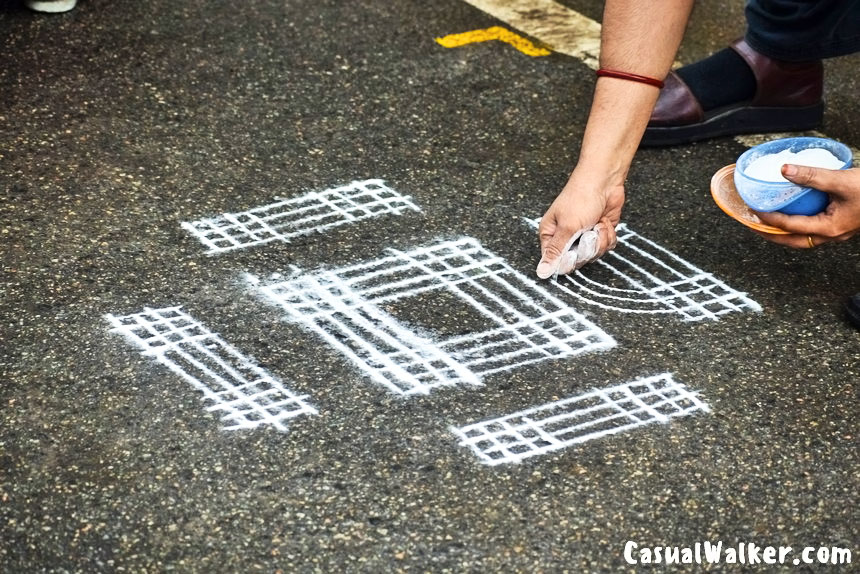
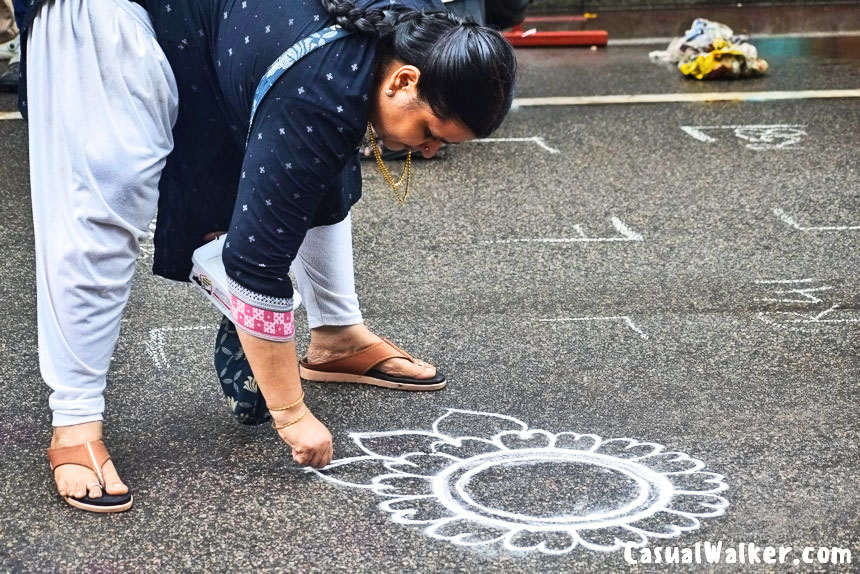
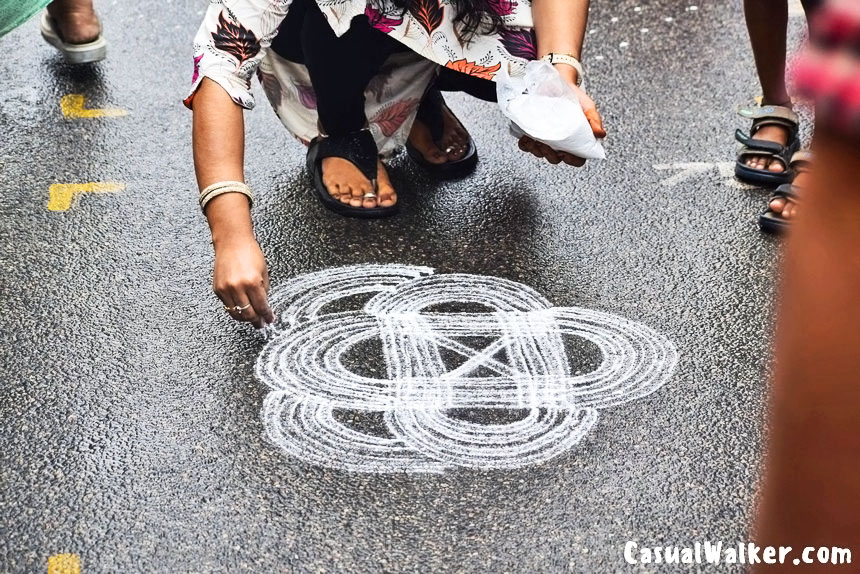
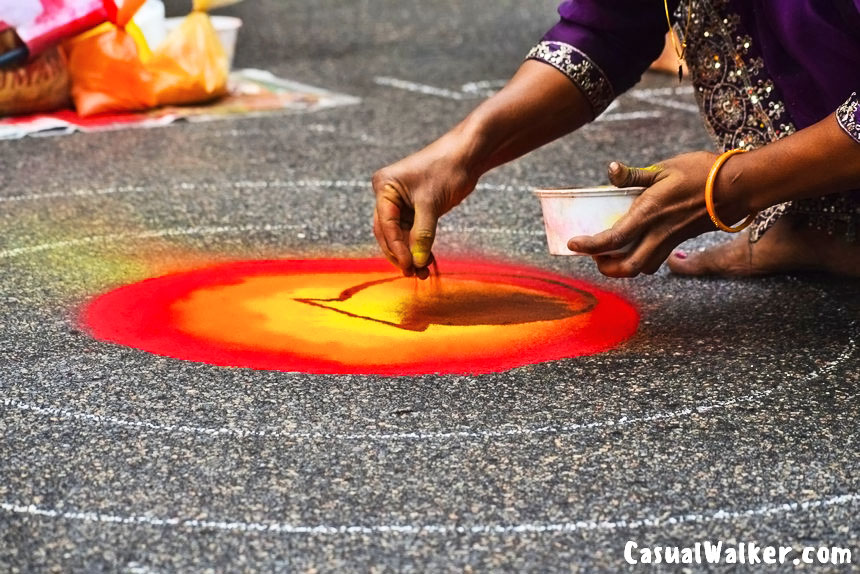
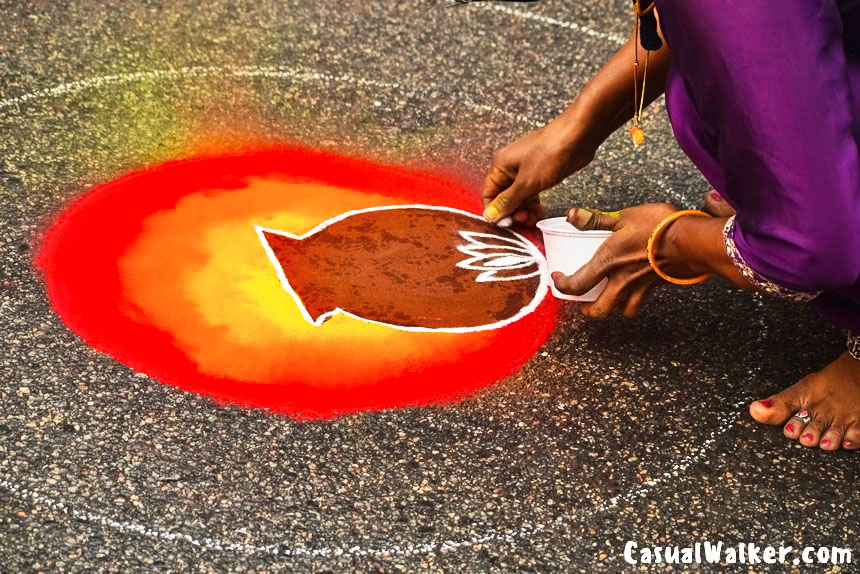
The excitement was palpable as each artist located their assigned square and began preparing their creative space. Watching how each person, regardless of age or background, engaged with this ancient art form was nothing short of revelatory.
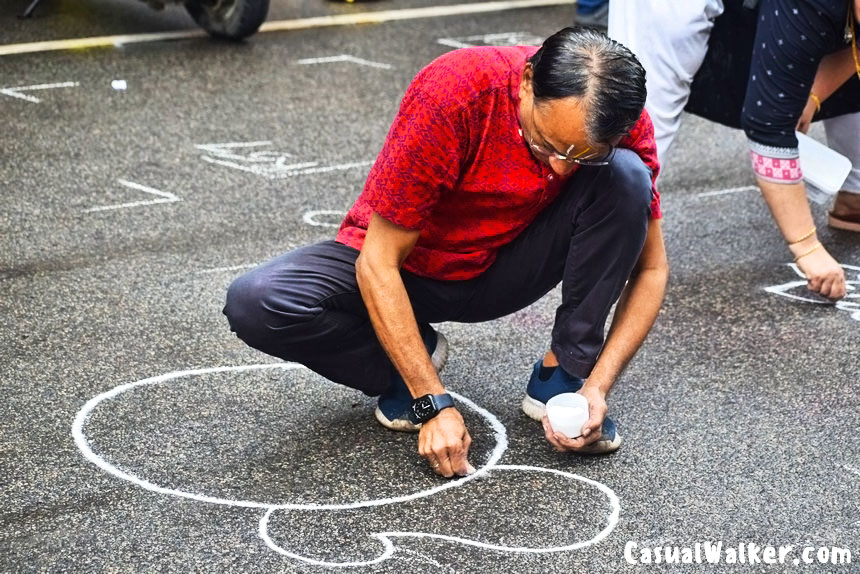
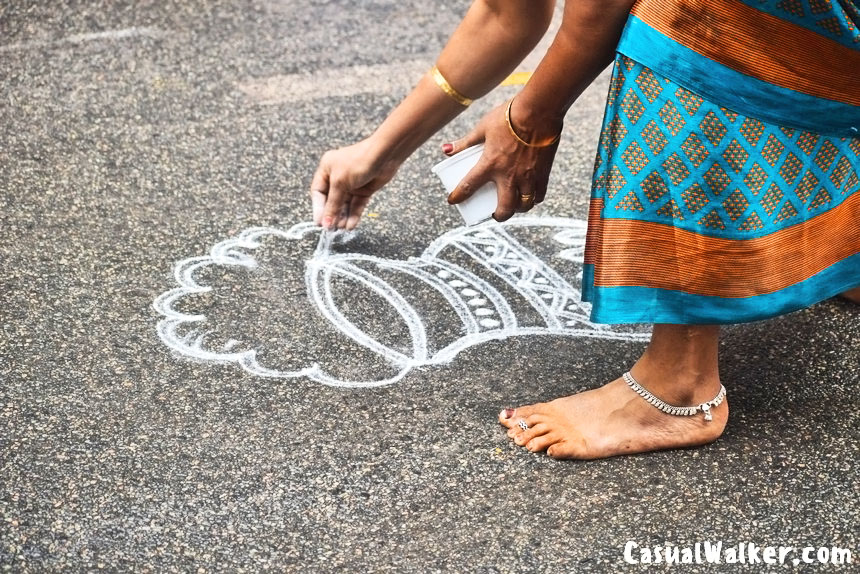
Kolam and Rangoli: Understanding This Ancient Art Form
The Kolam (also known as rangoli in North India) is the quintessential South Indian art form where intricate patterns are drawn at home entrances using rice flour or colored powders. These aren’t mere decorations—they’re sacred geometry, daily prayers rendered in powder, believed to invite prosperity and positive energy while offering food to ants and small creatures.
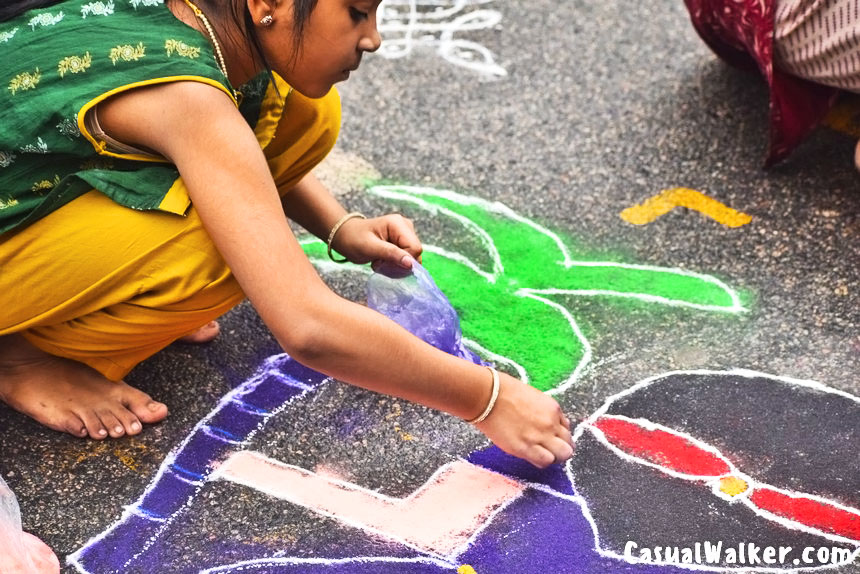
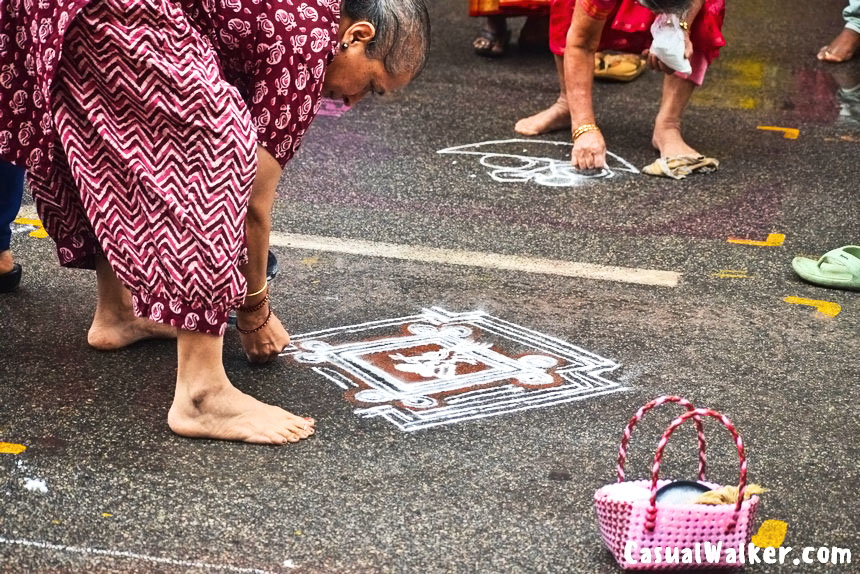
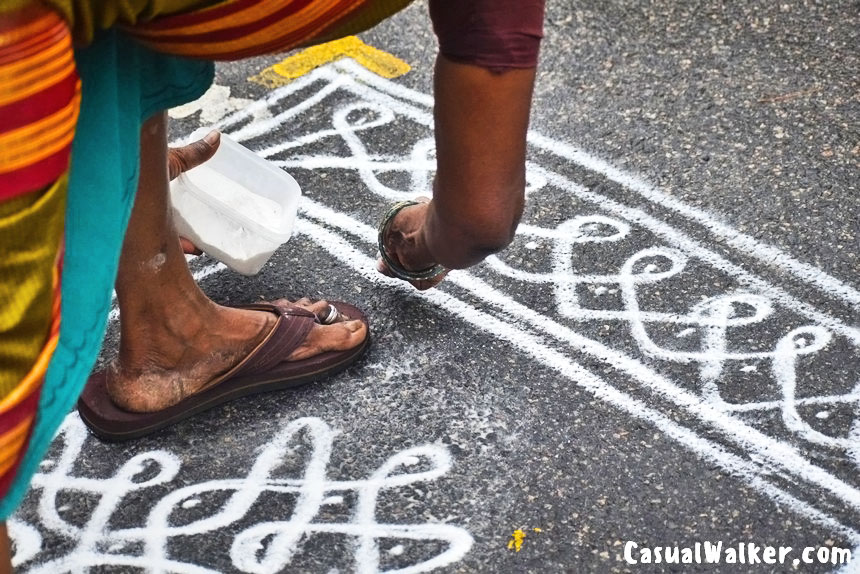
Mesmerizing Types of Kolam I Witnessed at the Kolam Festival
Pulli Kolam (Dot Kolam): The classic technique where dots form a grid, and lines weave through them in unbroken patterns. Watching artists create these without lifting their hands is like watching calligraphy in slow motion—hypnotic and meditative. The mathematical precision required is astounding; one miscalculation and the entire symmetry collapses. I observed countless variations, from simple 3×3 dot grids to elaborate 15×15 matrices that covered entire squares.
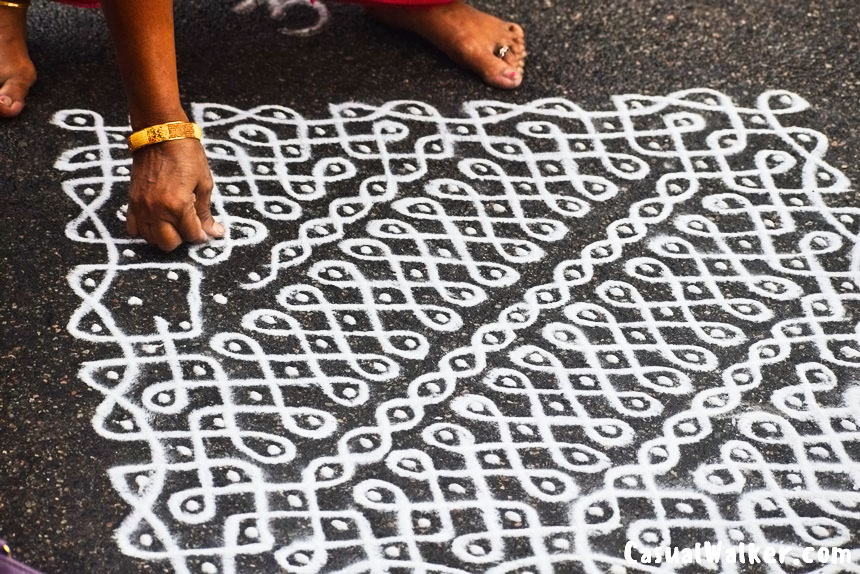
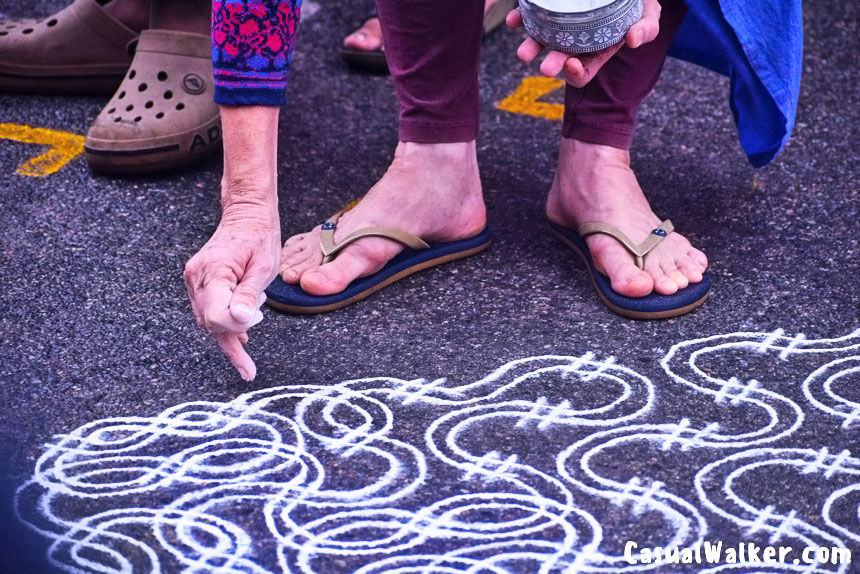
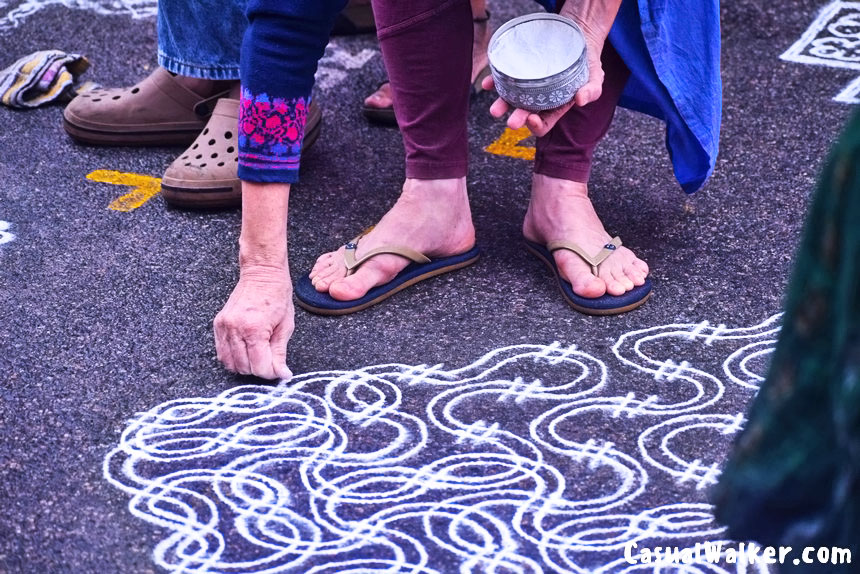
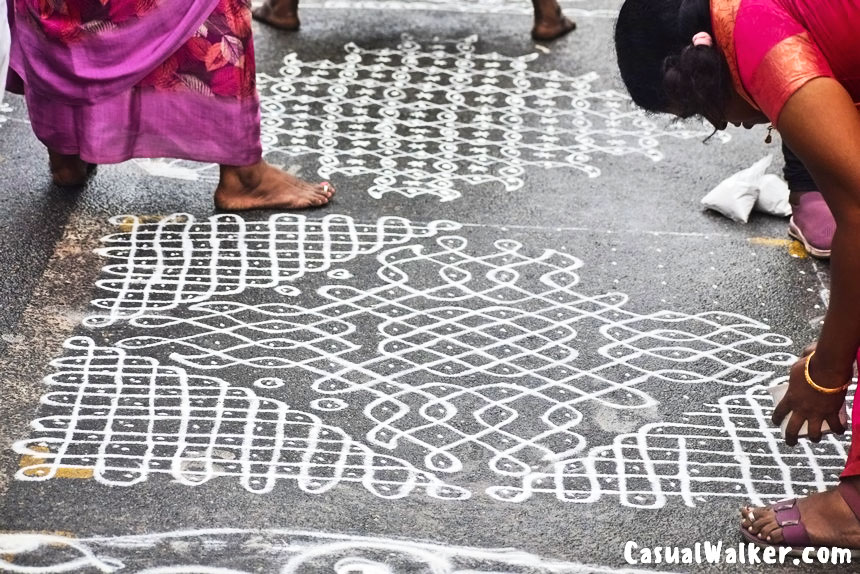
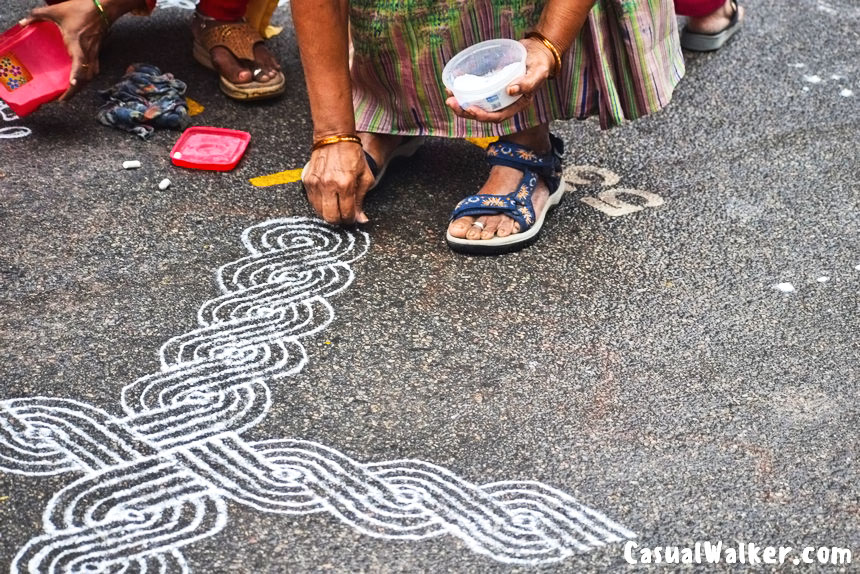
Chikku Kolam (Sikku Kolam): These intricate interlocking patterns resemble Celtic knots or mandala designs. I spent nearly thirty minutes photographing one elderly woman creating a Chikku kolam that looked like it could unlock ancient secrets. The interconnected loops symbolize the interconnectedness of life itself. These designs required incredible spatial awareness and planning—there’s no room for error when every line must connect perfectly with the next.
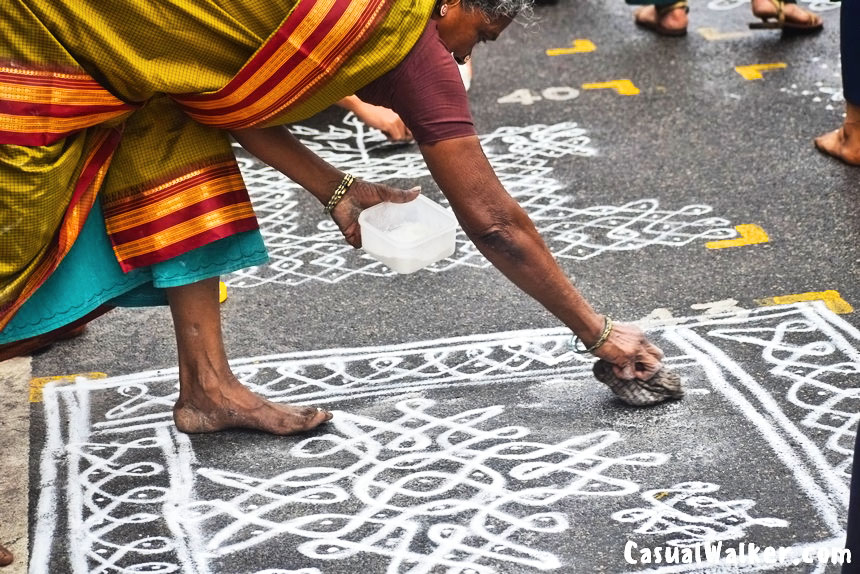
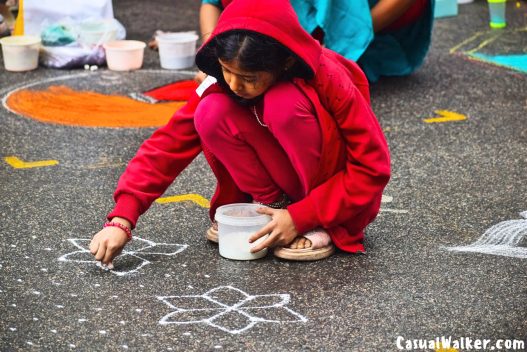
Kambi Kolam (Rope Kolam): These designs mimic braided ropes and woven patterns. I watched a young girl, barely ten years old, creating one with such confidence that a crowd gathered around her. Her grandmother stood nearby, beaming with pride—a beautiful generational transfer of heritage I was privileged to witness.
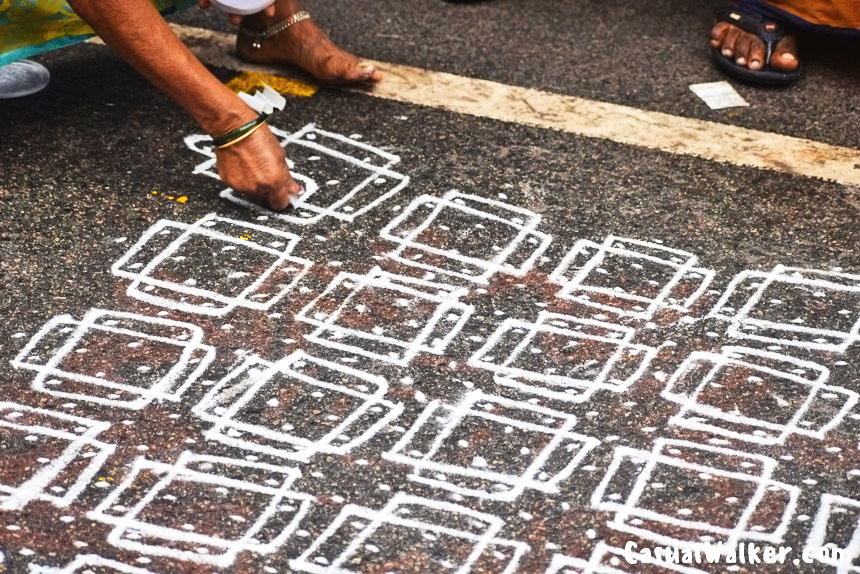
Neli Kolam (Freehand Kolam): The rebels of the kolam world! No dots, no grids—pure artistic freedom. These often feature peacocks, lotus flowers, temple gopurams, and abstract interpretations. I photographed one participant creating a stunning peacock that seemed ready to dance off the street, each feather rendered with remarkable detail.
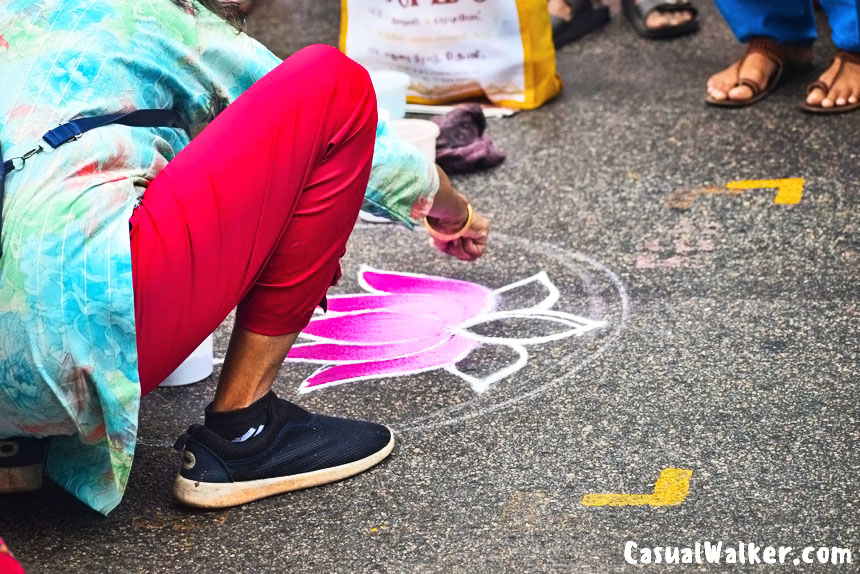
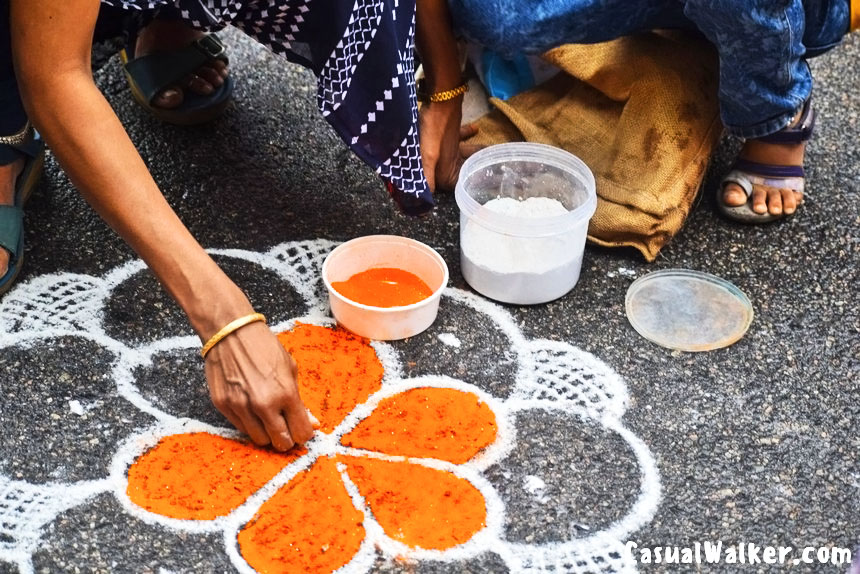
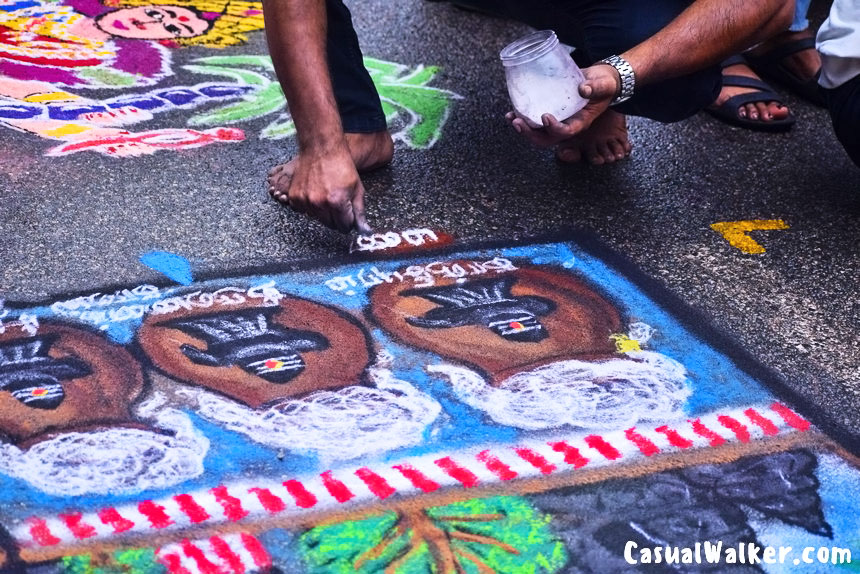
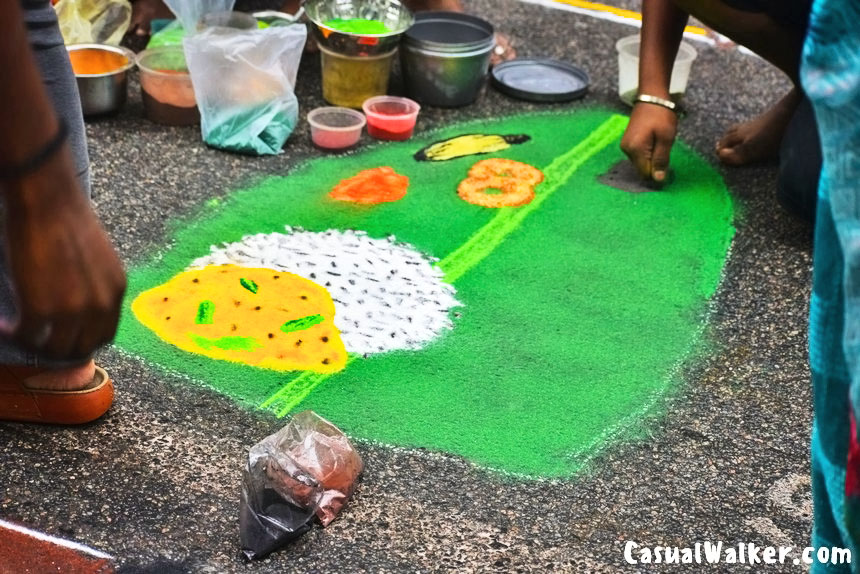
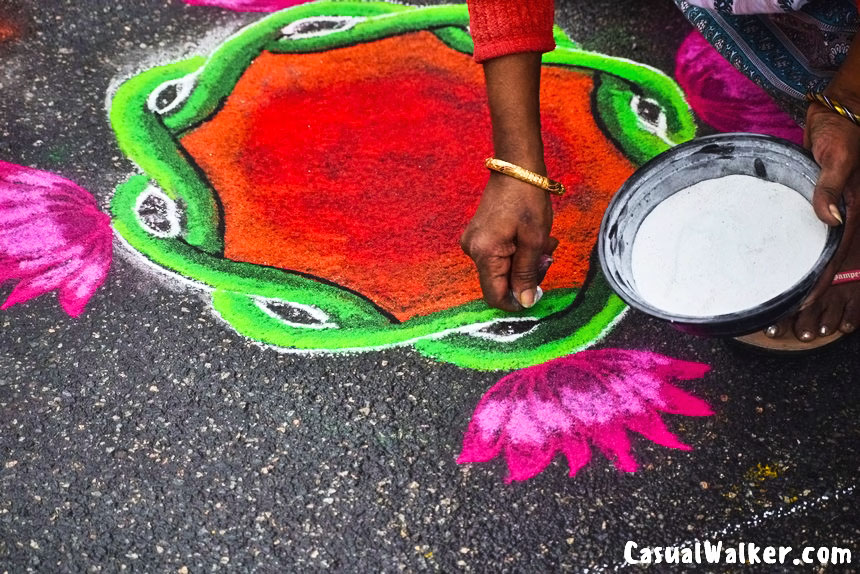
Rangoli (Colored Kolam): While traditional kolams use white rice flour, rangolis burst with vibrant colors—turmeric yellows, vermillion reds, emerald greens, and sapphire blues. The festival showcased both, creating a visual spectrum that photographers dream about. The contrast between monochromatic elegance and kaleidoscopic exuberance was breathtaking.
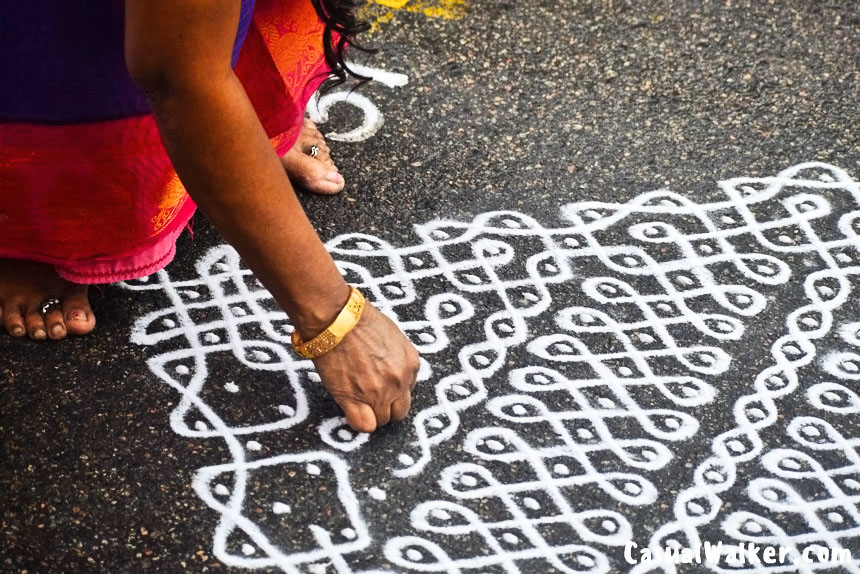
Poetry of Monochrome vs. The Symphony of Color
Standing on North Mada Street, I was struck by the profound artistic dialogue between monochrome kolams and colored rangolis—two expressions of the same cultural soul, yet so different in their visual language.
Monochrome Kolam: Visual Music in White
There’s something profoundly meditative about the traditional white kolam. Watching these emerge on the dark asphalt was like witnessing musical compositions being written in powder. Each monochrome kolam became a visual song, with its own rhythm and melody expressed through graphical elements.
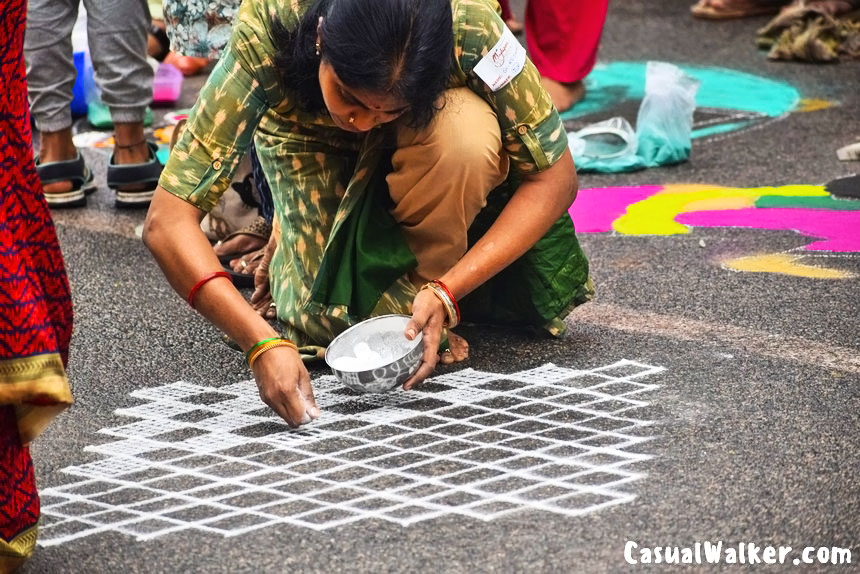
The thick contours created by some artists produced bold, confident statements—like the deep resonance of a mridangam drum. These designs commanded attention from a distance, their heavy lines anchoring the eye. I captured one design featuring thick, dramatic borders that framed delicate interior patterns, creating a stunning interplay of weight and lightness.
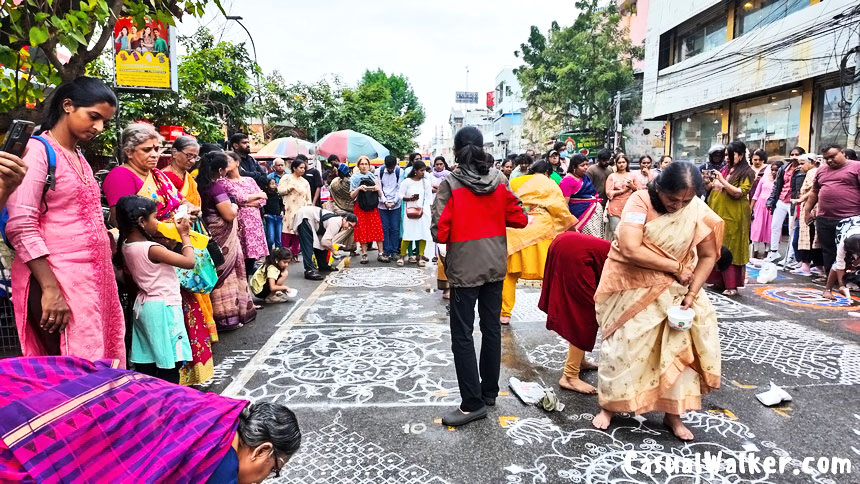
In contrast, the thin, delicate contours others chose were like the whisper of a flute—subtle, refined, requiring you to lean in closer to appreciate their intricacy. I found myself kneeling to photograph designs with hairline-thin connections between dots, so fine they seemed to float above the street rather than rest upon it.
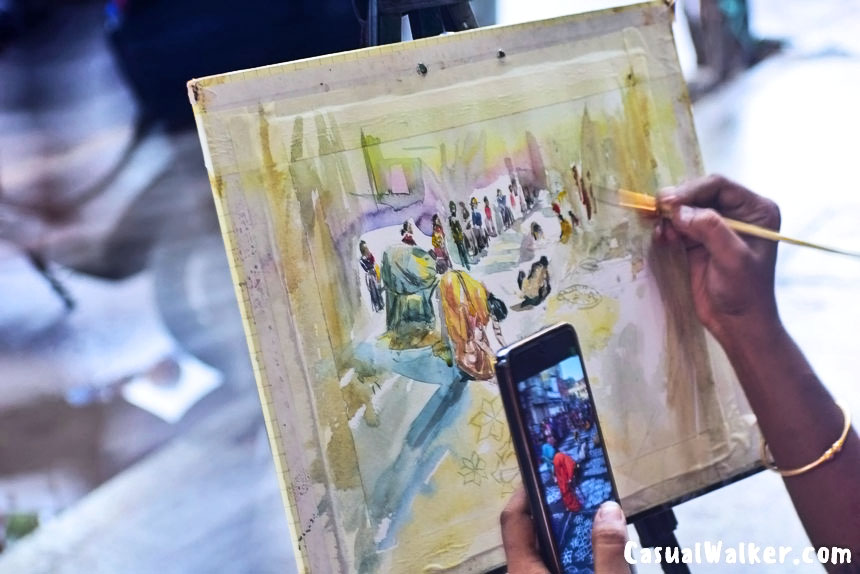
The spacing of dots created entirely different rhythms. Closely-spaced dots generated dense, compact compositions intense, concentrated energy contained within boundaries. These designs felt like rapid percussion, quick and intricate. Dispersed dots, spread wide across the designated square, created expansive, breathing compositions where negative space became as important as the lines themselves—like the deliberate pauses in classical music that give meaning to the notes.
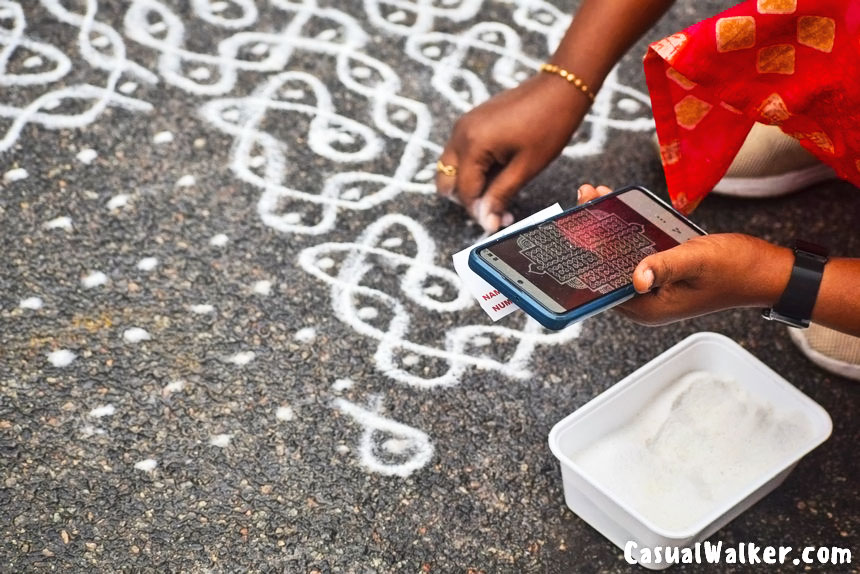
The line work was where I saw the most musical variation. Wide lines moved across the street with confidence and authority, snaking boldly around dots in sweeping curves that felt like the movement of a dancer’s arms. Fine lines traced more tentative, delicate paths—tame and controlled, creating geometric precision that satisfied something mathematical in the soul.
Some artists created snaking, flowing lines that undulated with organic grace, never quite predictable, always surprising the eye with their next turn. These felt alive, breathing, almost liquid in their movement. Others preferred tame, disciplined lines—straight when needed, curved with perfect mathematical precision, creating order and harmony that felt like visual meditation.
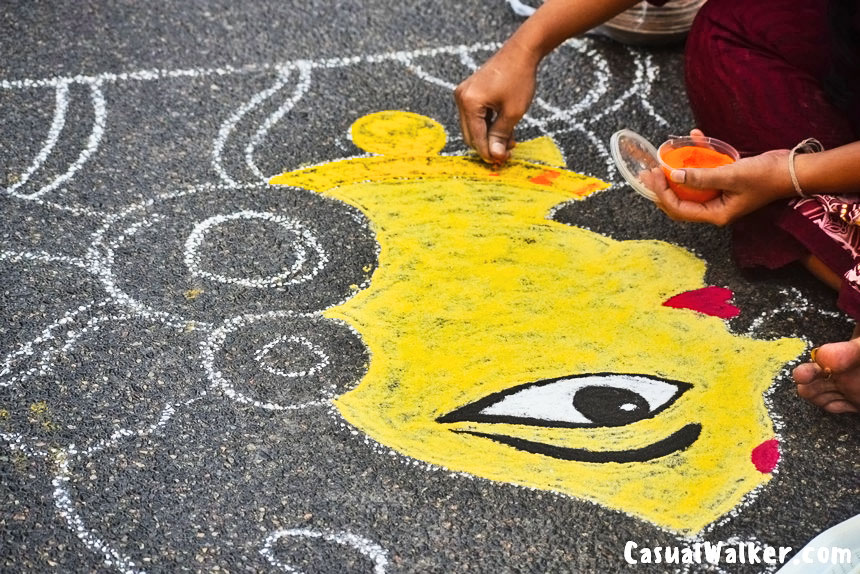
Each monochrome kolam was indeed a song enriching the magnificent bouquet of images that makes up Tamil visual tradition. Walking along the street, I felt like I was experiencing a visual concert—each design a different movement in a grand symphony, each artist a composer expressing their unique voice within an ancient musical tradition.
Colored Rangoli: Kaleidoscopic Celebration
If monochrome kolams were musical compositions, the colored rangolis were full orchestral performances with every instrument playing at once—exuberant, joyful, impossible to ignore.
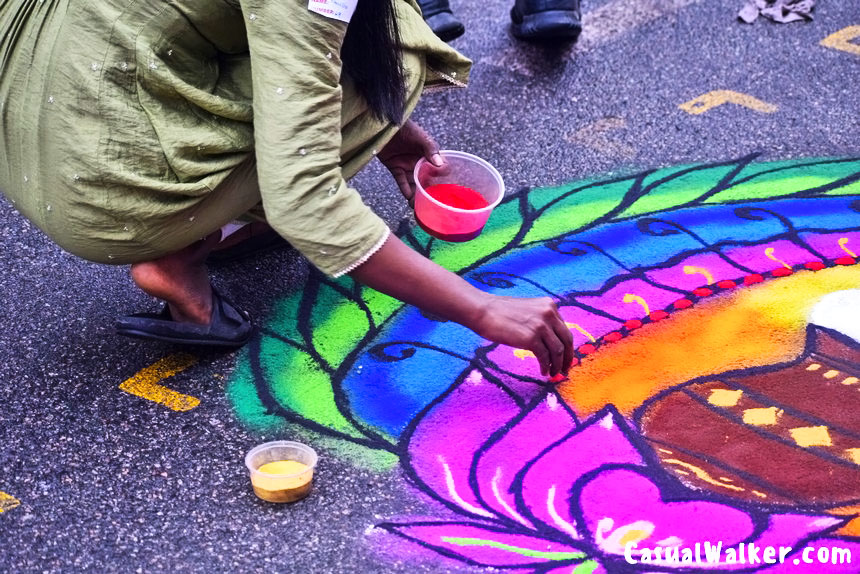
The vibrant rangolis didn’t just occupy space—they claimed it, celebrated it, transformed it into explosions of joy. Turmeric yellows glowed like captured sunlight. Vermillion reds pulsed with energy and auspiciousness. Emerald greens brought nature onto the concrete. Sapphire blues evoked both sky and divinity.
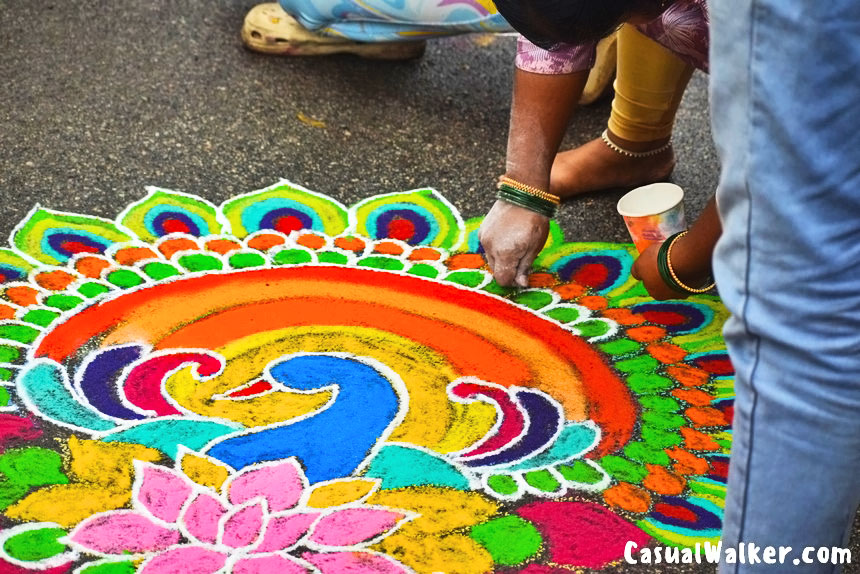
What fascinated me was how color changed the emotional register entirely. A peacock rendered in monochrome white possessed elegance and classical grace. The same peacock exploding in blues, greens, and golds became a celebration, a festival within the festival. The colors added layers of meaning—each hue carrying its own cultural and spiritual significance in Tamil tradition.
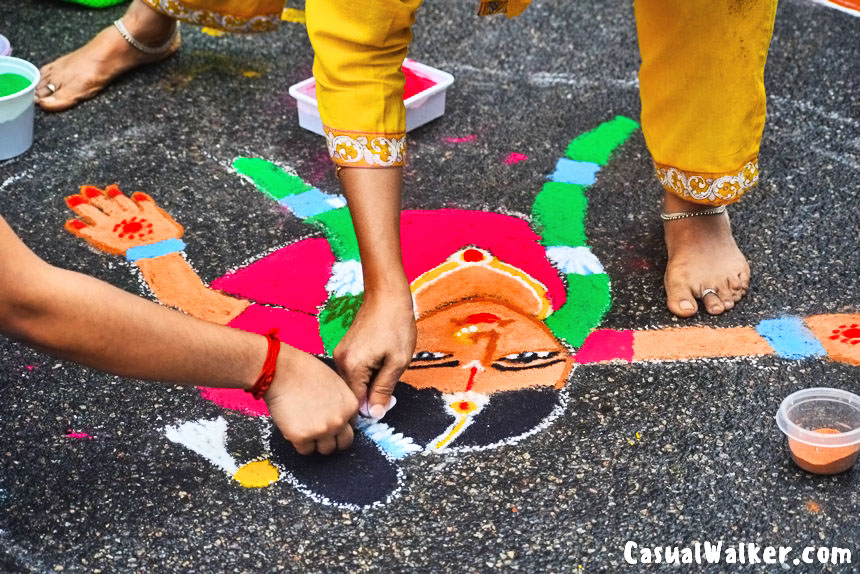
I just loved capturing this artists creating gradient effects, blending colors with such skill that oranges melted into reds, blues dissolved into purples. These Kolams / rangolis captured the essence of Chennai’s famous sunsets, or the way a silk saree’s colors shift in different lights.
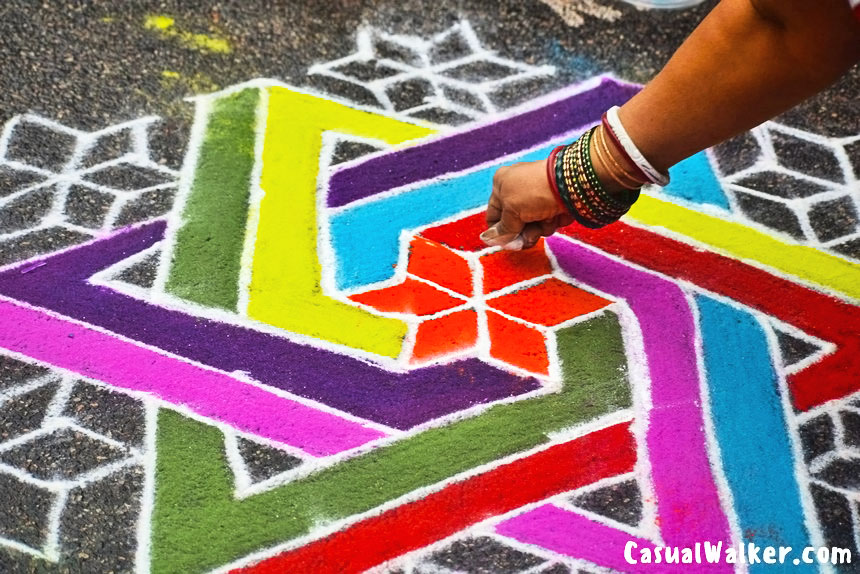
The interplay between monochrome and colored designs across North Mada Street created a visual rhythm all its own—the quiet, contemplative whites providing breathing space, visual rest stops between the jubilant color explosions. Together, they represented the full spectrum of Tamil artistic expression: restraint and exuberance, meditation and celebration, whisper and song.
Participants: A Beautiful Tapestry of Humanity United by Art
What made this year’s Kolam Festival truly extraordinary was the incredible diversity and passionate engagement of participants. This wasn’t a competition dominated by professionals or a specific demographic—it was a true intergenerational, cross-cultural celebration where every participant brought their unique story to the street.
Little Masters: Children’s Unbridled Creativity
The children were absolutely mesmerizing. I watched a five-year-old girl in a bright pink pavadai (traditional skirt) kneel beside her square, her concentration so intense that she stuck her tongue out slightly—that universal sign of a child deep in creative flow. Her mother had helped her mark the initial dots, but the little one insisted on drawing the connecting lines herself. When she made a small mistake, instead of erasing, she incorporated it into a flower design. Pure creative problem-solving that I captured in a beautiful sequence of photographs.
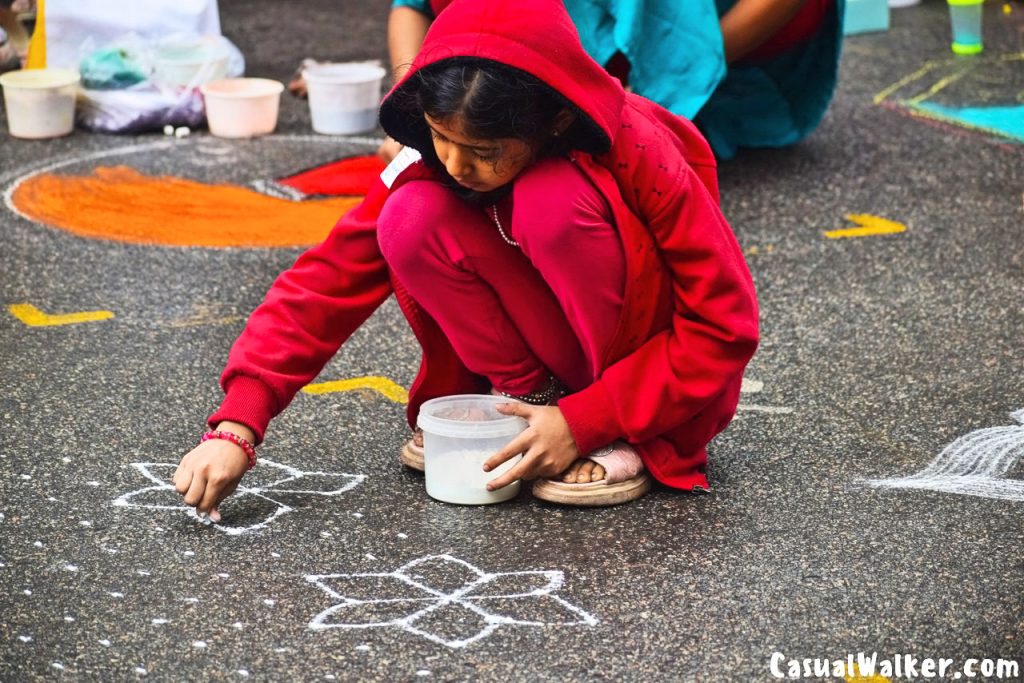
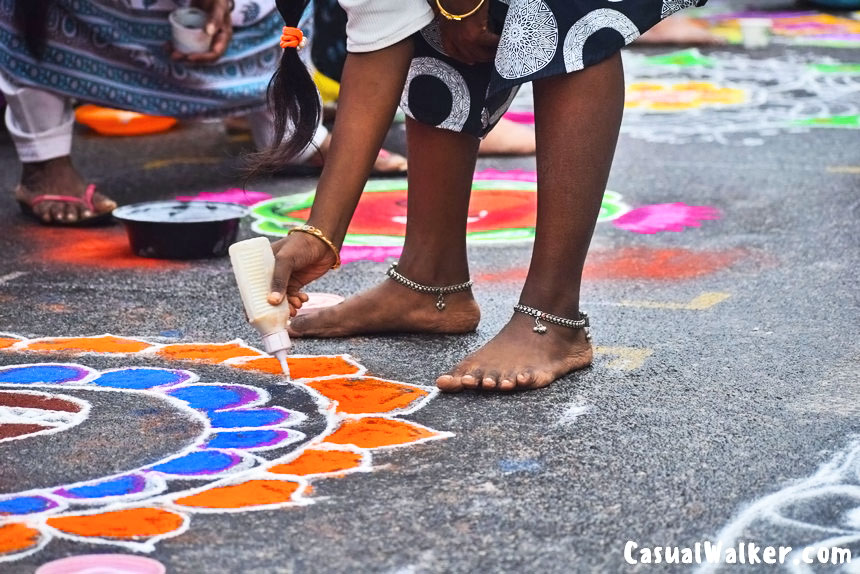
A group of school-aged children (around 8-12 years old) had come together as a team. They’d clearly practiced, because they worked with remarkable coordination—one would create the outer border while another filled in the center. Their design featured a traditional temple gopuram surrounded by geometric patterns. Every few minutes, they’d step back, assess their work, and adjust. Their animated discussions about symmetry and color choices were adorable and showed deep understanding of the art form.
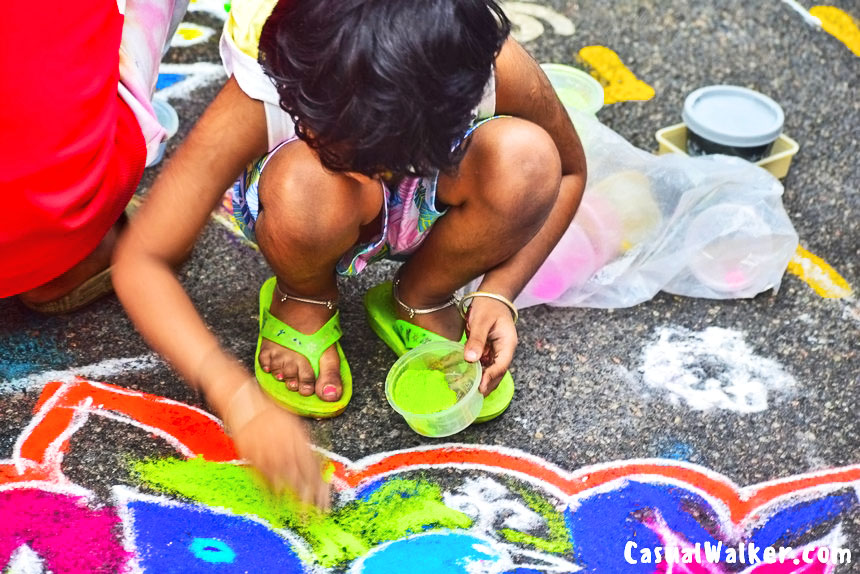
I seen one seven-year little girl creating what appeared to be a traditional mathematical kolam with remarkable precision. Her grandmother watched from nearby, and the pride on her face told me this was knowledge passed down through generations. The child worked with absolute focus, carefully ensuring each dot connected properly to create the unbroken pathway that defines pulli kolam.
Teenagers: Tradition Meets Contemporary Vision
The teenage participants brought a fascinating blend of respect for tradition and contemporary interpretation. I spent considerable time photographing a group of three teenage girls creating an absolutely stunning colored rangoli featuring a peacock with elaborate tail feathers. What made it special was how they’d incorporated environmental messages into the design, with subtle representations of trees and water drops woven into the traditional motifs.
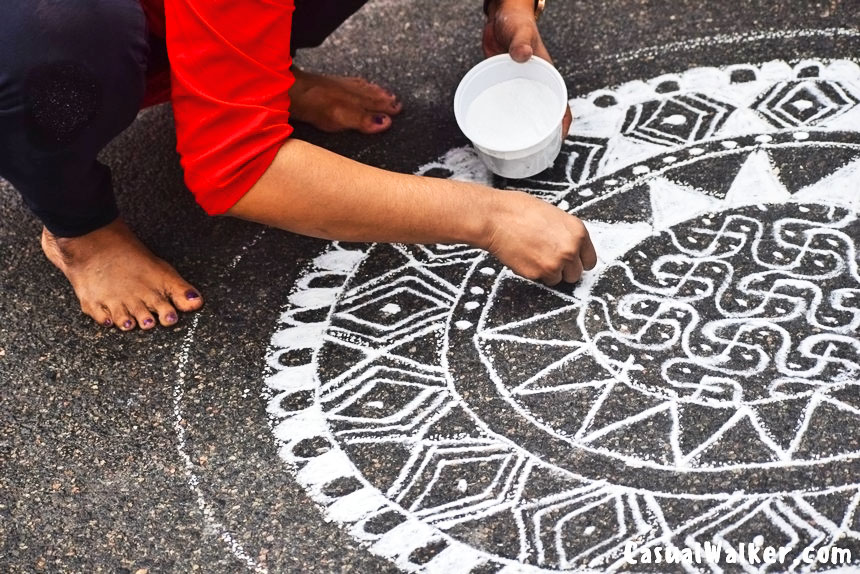
A teenage boy, perhaps 16, worked alone with headphones on (though I noticed he wasn’t actually playing music—just blocking out distractions). His design was a complex Chikku kolam that demonstrated serious mathematical thinking. I watched his methodical approach, each line carefully planned before execution. His father stood at a distance, respecting his son’s need for concentration but unable to hide his pride.
Breaking Barriers: Men Embracing Kolam Culture
This year witnessed something truly special—unprecedented male participation across age groups. Traditionally, kolam has been primarily women’s domain, but the Mylapore Festival is actively changing that narrative.
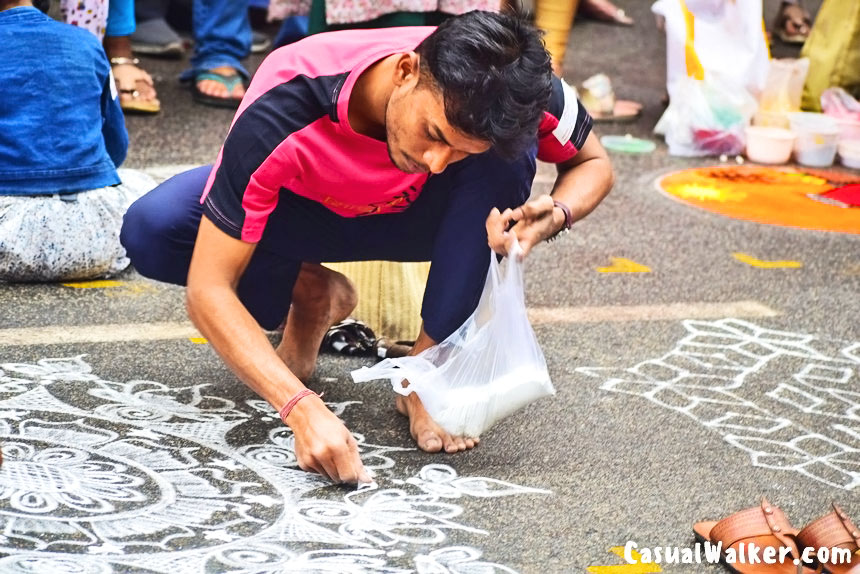
I documented a middle-aged man creating his first-ever public kolam. His hands trembled slightly with nervous excitement as he began marking dots. His wife stood nearby, offering gentle tips and encouragement. His design was simpler than some others—a lovely Kambi kolam pattern—but the joy on his face when he completed it was priceless to capture.
An elderly gentleman, perhaps in his seventies, was creating an extraordinarily intricate pulli kolam with the steady hands of someone who’d done this many times before. I approached respectfully to photograph his work, and watched as he moved with practiced confidence, never hesitating, each line flowing naturally from muscle memory accumulated over decades.
A father-son duo worked together on a large design, their collaborative energy beautiful to witness. They’d clearly divided responsibilities—the father laid the structural foundation while the son added decorative elements. They consulted each other constantly, and I captured several shots of their hands working in tandem, representing how traditions evolve through dialogue across generations.
Grandmothers: Living Libraries of Kolam Wisdom
The most moving participants were undoubtedly the elderly women—repositories of kolam knowledge accumulated over 50, 60, even 70 years of daily practice. These weren’t just participants; they were living masters, cultural treasures in cotton sarees and jasmine flowers.
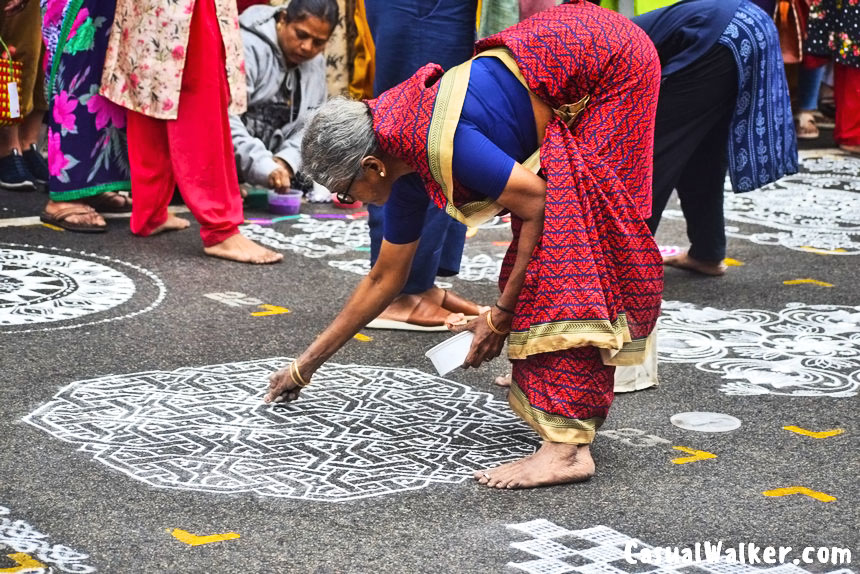
One grandmother in a traditional nine-yard madisar saree created a breathtakingly complex forty foot Chikku kolam. I spent over an hour photographing her process, watching her hands move with the confidence of muscle memory no hesitation, no mistakes, pure flow. A small crowd gathered to watch, and she worked with quiet dignity, occasionally explaining techniques to younger participants who approached her with reverence.
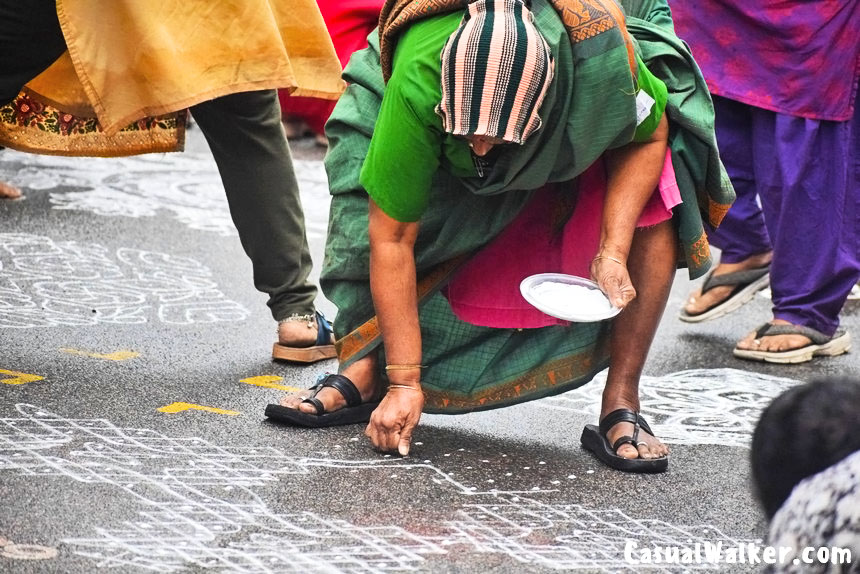
Another elderly woman sat on a small stool (concession to aching knees) and created a traditional pulli kolam that demonstrated generations of accumulated skill. What touched me deeply was how several younger participants—both women and men—kept approaching her for guidance. She became an informal teacher, and I documented these moments of knowledge transmission, watching her gnarled fingers gently correct a young woman’s technique or demonstrate the proper way to connect dots.
Women: Showcasing Mastery and Innovation
Women of all ages dominated the participation, as they should in an art form they’ve historically preserved and perfected. Watching their diverse approaches was fascinating.
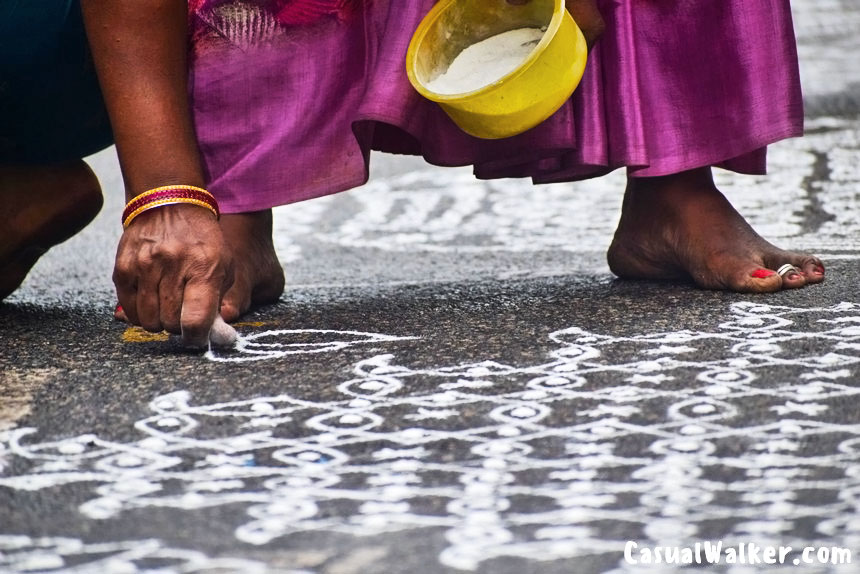
Young mothers often participated with toddlers in tow, somehow managing to create intricate designs while simultaneously keeping children entertained. I photographed one mother who had strapped her infant to her back in a traditional carrier and created a stunning lotus rangoli with focused dedication, rhythmically swaying to keep her baby content. Multitasking elevated to art form.
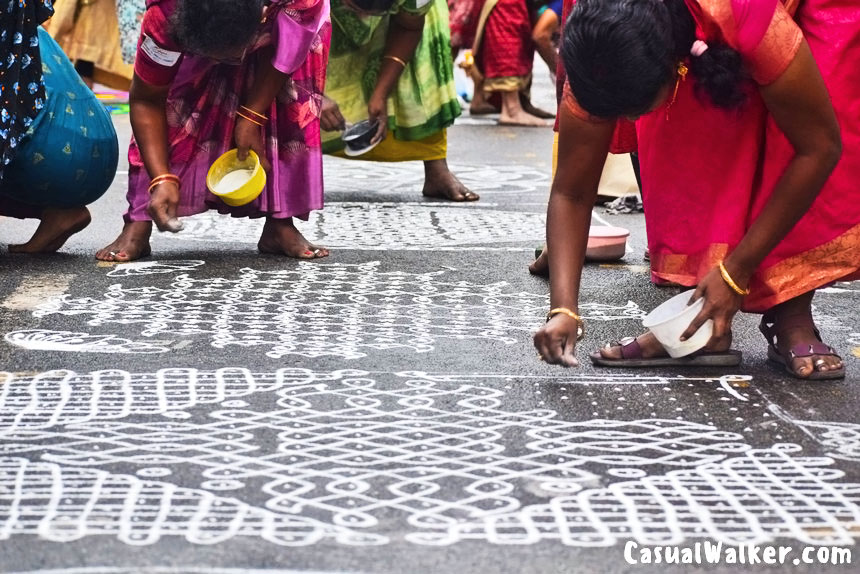
Middle-aged women, many of whom do kolam daily at home, approached the festival as a platform to showcase family patterns passed down through generations. I documented several women creating what were clearly ancestral designs, each telling me through gestures and expressions that these patterns connected them to their mothers, grandmothers, and great-grandmothers.
Global Embrace: Foreign Participants
The presence of international participants added a beautiful dimension of cultural exchange. I photographed a couple from France working together on a design, guided patiently by a local volunteer. Their technique was understandably shaky, their symmetry imperfect, but their respect and enthusiasm were genuine and touching. I captured the cross-cultural mentorship happening spontaneously no formal teaching program, just organic knowledge sharing.
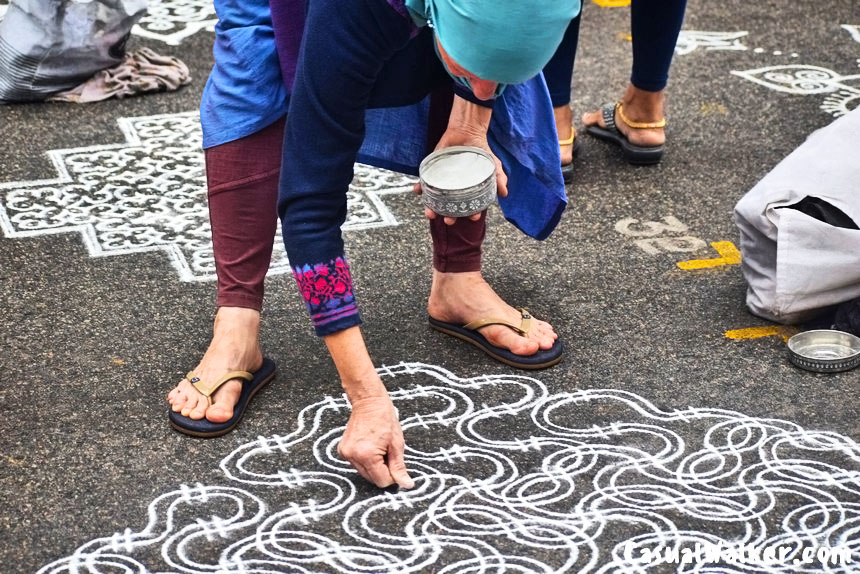
A Foreign tourist with impressive attention to detail created a geometric kolam that drew on aesthetic sensibilities—clean lines, mindful use of negative space, subtle elegance. I spent time photographing her work, seeing how art truly is a universal language that transcends borders.
Atmosphere: Electrifying Yet Meditative
As the evening event officially began, something magical happened. The buzz of conversation didn’t disappear, but it transformed into a different kind of energy—focused, purposeful, creative. Hundreds of people, kneeling on the still-damp street, began creating simultaneously.
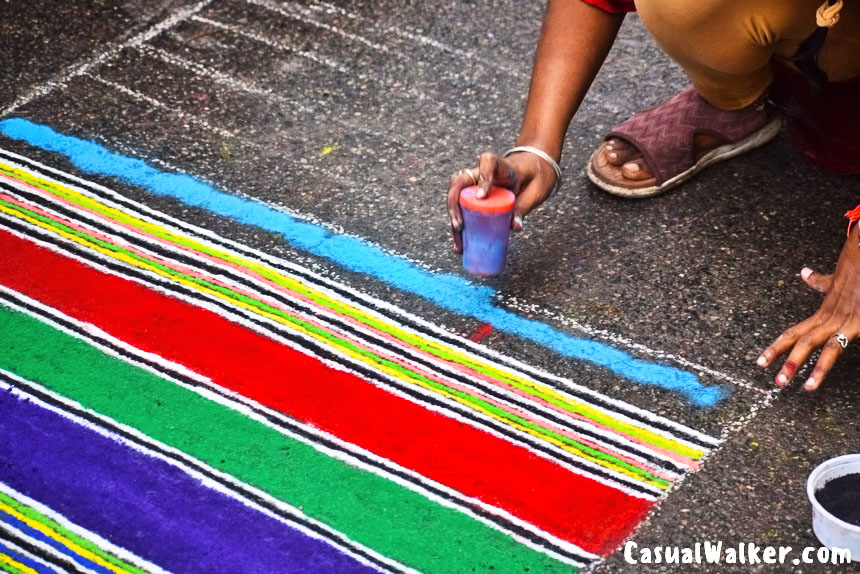
The kaleidoscope of colors and patterns that emerged over the next hours was staggering. White rice flour patterns provided elegant contrast against dark asphalt, made even more dramatic by the moisture from the earlier rain. Vibrant rangolis exploded with sunset oranges, peacock blues, lotus pinks, turmeric yellows. Some designs featured traditional motifs: lotuses symbolizing purity, peacocks representing beauty, geometric mandalas suggesting cosmic order. Others showcased modern interpretations—abstract patterns, contemporary themes, even social messages woven into ancient techniques.
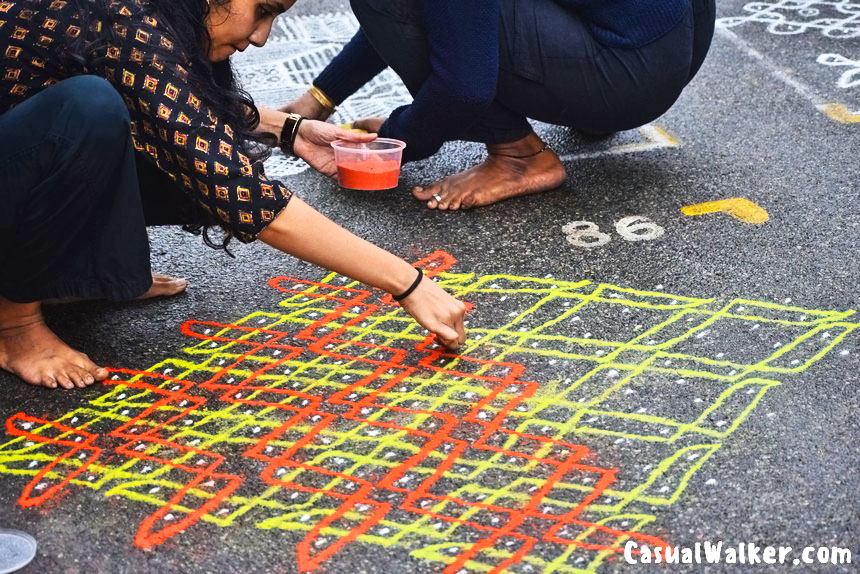
The evening light shifting toward dusk created a photographer’s paradise. The post-rain atmosphere gave everything a soft, ethereal quality, and the moisture on the street made the colors appear even more vibrant and luminous. As I walked along North Mada Street, weaving between participants and observers, I felt like I was walking through a living, breathing art gallery where every few feet offered a new masterpiece.
Mylapore: Where Spirituality, Heritage, and Art Converge
To understand the Kolam Festival, you must understand Mylapore—Chennai’s oldest and most culturally significant neighborhood. This isn’t just a location; it’s a living heritage zone pulsating with spiritual energy.
Spiritual Heart of Chennai
Dominating the landscape is the magnificent Kapaleeswarar Temple, with its towering gopuram visible from blocks away. This 7th-century Shiva temple isn’t just an architectural marvel—it’s the spiritual nucleus around which Mylapore’s entire cultural ecosystem revolves. During the Margazhi month (December – January), when the festival occurs, the area transforms into a spiritual carnival. Early morning bhajans echo through streets, classical Carnatic music wafts from concert halls, and the scent of jasmine and incense becomes the neighborhood’s signature perfume.
I’ve photographed temples across India, but there’s something uniquely powerful about Kapaleeswarar during Margazhi. The energy is palpable, the devotion tangible, the artistic expression everywhere you look.
Hindu Cultural Significance
Mylapore represents Tamil Hindu culture at its most authentic. The “Maada Veedhis” (temple streets) around Kapaleeswarar form concentric circles of sacred geography where every stone tells a story. During the festival, these streets buzz with vendors selling everything from traditional bronze lamps to handwoven silk sarees, from filter coffee to homemade sweets. It’s commerce infused with devotion, where even a simple transaction feels like a cultural exchange.
The timing of the festival during Margazhi is significant this is considered the most auspicious month in the Tamil calendar, when the divine is believed to be most accessible. The Mylapore Festival captures this heightened spiritual energy and channels it into celebration.
Art and Heritage Epicenter
Mylapore has been home to legendary artists, musicians, dancers, and scholars. The neighborhood’s cultural DNA is encoded in its very architecture—the traditional agraharam houses with their tiled roofs and wooden pillars, the small sabhas (cultural halls) where classical music concerts happen nightly during the December “season,” and the street corners where impromptu performances erupt.
The Kolam Festival embodies this democratic approach to art, where a homemaker’s design commands as much respect as a trained artist’s work. As a photographer documenting culture, this egalitarian spirit is what makes Mylapore’s festivals so authentic and powerful.
Kolam Festival : More Than Just Pretty Patterns
The Sundaram Finance Mylapore Festival, now in its 22nd edition, represents something crucial—the preservation and evolution of intangible cultural heritage. Born 28 years ago as a modest door-to-door kolam contest by Mylapore Times newspaper, it has blossomed into a major cultural phenomenon attracting thousands.
From my perspective as someone who documents Indian traditions worldwide, I see how critical events like this are. Kolam isn’t just art it’s mathematical education disguised as tradition, mindfulness practice promoting concentration and memory, environmental consciousness using biodegradable materials, community building bringing neighbors together, gender equality advocacy (increasingly), and intergenerational knowledge transfer keeping traditions alive.
In our increasingly digital age, where children’s creativity often finds expression through screens, watching them create something tactile, ephemeral, and beautiful with their hands felt revolutionary. I photographed children completely absorbed in their work, screens forgotten, hands covered in colored powder, minds focused on geometry and beauty.
Broader Festival Experience
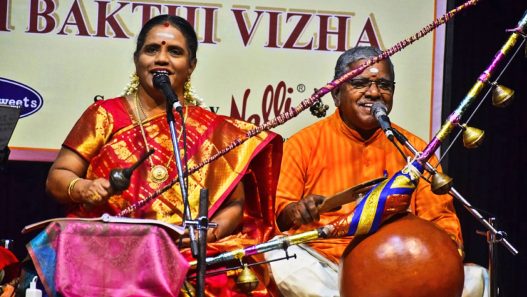
While the Kolam Festival is the visual centerpiece, the four-day Sundaram Finance Mylapore Festival 2026 offers much more. Classical dance performances transform temple courtyards into stages. Food walks introduce visitors to Mylapore’s legendary culinary heritage—from crispy vadas at century-old eateries to aromatic filter coffee served in traditional “tumbler and davara” sets. Craft exhibitions showcase traditional Tamil arts—bronze casting, wooden toy making, silk weaving.
The festival recreates the “Thiruvizha” atmosphere—the traditional temple festival vibe where spirituality, commerce, entertainment, and community converge. It’s a deliberate effort to keep alive the cultural ecosystem that once thrived naturally but now needs conscious preservation.
Practical Tips for Future Visitors
- Event timing: The Kolam competition begins in the evening—arrive early to see preparations and claim a good viewing/photography position.
- Weather consideration: January evenings in Chennai can bring light drizzles, but events continue. The post-rain atmosphere actually enhances the visual impact of the designs.
- What to bring: Camera with good lens for close-ups and wide-angle shots, comfortable footwear that you don’t mind getting dusty, lens cloth (the powder can be messy), extra batteries, water bottle.
- Photography etiquette: Be respectful of participants’ space. Ask before taking close-up portraits. Don’t cast shadows on works in progress.
- Engage respectfully: Artists usually appreciate genuine interest. A smile and respectful observation go a long way.
Street as Temple
I understood something profound documenting this festival. The Mylapore Kolam Festival isn’t preserving a dying tradition—it’s proving that tradition can evolve, include, and inspire without losing its essence. Mylapore Kolam Festival 2026 wasn’t just a visual feast—it was a spiritual education, a lesson in community, and a reminder that the most profound art often happens not in galleries but on streets, not for collectors but for the collective soul.
The light drizzle that had threatened the event earlier in the evening seemed, in retrospect, like a blessing—cleaning the canvas, adding atmosphere, reminding us that beauty and tradition persist regardless of conditions. Just as the rain stopped to allow the festival to proceed, traditions adapt and survive, finding new expressions while honoring ancient roots.