




Sri Singirikudi Narasimha Temple / Sri Lakshmi Narasimha Swamy Temple, Singirikudi (Sringirikudi), Thavalakuppam, Near Pondicherry: One of the Nerkottu Narasimhar Temples / Three-Temple Circuit & Nava Narasimha Temples of Tamil Nadu – Ancient Ugra Narasimhar Temple with Rare Fierce 16-Handed Form (Singar Koil) – Navagraha Dosha Parihara Sthalam, History, Contact Details, Temple Architecture, Temple Timings, Festivals, Nearby Temples, How to Reach & Complete Pilgrim Travel Guide (Updated)
– 1,500 year-old lord narasimha temple built by pallava dynasty

Singirikudi village is located just 6 kilometres from Pondicherry on the Pondy–Cuddalore bus route and about 3 kilometres west of the Abhishekapakkam road junction in Cuddalore district, the Sri Lakshmi Narasimha Swamy Temple stands as one of Tamil Nadu’s most powerful and ancient Vaishnava shrines. 
Popularly known as Ugra Narasimhar Temple or Singar Koil, this remarkable temple is believed to be over 1,500 years old and is counted among the celebrated Nava Narasimha temples of Tamil Nadu, nine sacred shrines dedicated to Lord Vishnu in his fierce Narasimha (half-lion, half-human) avatar. For devotees seeking relief from chronic illnesses, planetary afflictions, enemy troubles, and obstacles in life, this temple holds an especially revered place in the spiritual landscape of Tamil Nadu.
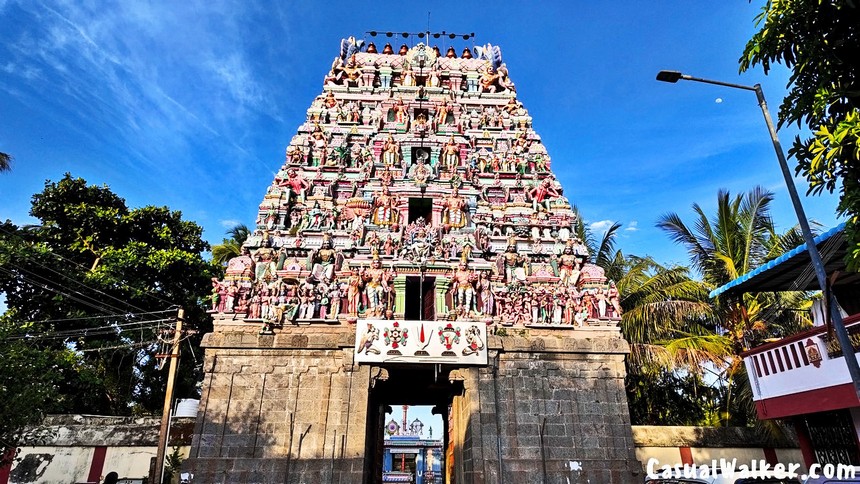
What makes Singirikudi even more unique among Narasimha temples is its sacred geography. It forms part of a celebrated trio of Lakshmi Narasimha temples, along with Sri Lakshmi Narasimha Swamy Temple at Poovarasamkuppam and Sri Lakshmi Narasimha Swamy Temple at Parikkalpattu, that lie along the same geographical line and are traditionally visited together in a single day by devoted pilgrims. This three-temple circuit is considered especially auspicious, and many devotees make it a point to complete all three darshans in one sacred journey.
Ancient Name and Royal Patronage
The ancient name of Singirikudi is Krishnaranya Kshetram, though the place has long been popularly known as Singar Koil among locals. The temple’s origins trace back to the Pallava dynasty in the 7th century AD, and it has been further developed, renovated, and patronised by the Chola kings and the Vijayanagara Empire, including the great King Krishnadevaraya, whose generous donations to this temple are recorded in stone inscriptions found within the premises.
The earliest mention of King Rajavarman is also associated with the founding of this sacred site. The sanctum sanctorum (Moolasthanam) as it stands today is believed to date to the 16th century, reflecting the Vijayanagara-era temple-building tradition that shaped much of South India’s temple architecture.
Sage Vasishtha at Singirikudi History
The great Sage Vasishtha and King Nimi, a tale that places Singirikudi at the centre of a profound story of pride, curse, and divine redemption.
King Nimi Chakravarthy was a deeply devout ruler who performed numerous yagnas (sacred fire rituals) for the welfare of mankind. Wishing to conduct a grand Indra Yagna, he approached his royal preceptor, Sage Vasishtha, and requested him to officiate. The sage expressed his inability to perform the yagna immediately but promised to return the following day. In the sage’s absence, King Nimi sought the help of Sage Koushika and conducted the yagna successfully.
After the yagna, the exhausted king retired to rest and instructed his guards not to allow any visitors. When Sage Vasishtha arrived to meet the king, the guards, following their orders, refused him entry. Enraged by this, Sage Vasishtha cursed King Nimi to lose his physical form and wander through the atmosphere without a body. The king, upon hearing of the curse, felt it was unjust for a sage to curse someone while asleep and reciprocated with an equal curse upon the sage. Both the sage and the king were thus condemned to wander as bodiless beings.
The assembled sages, moved by this situation, gathered to find a resolution. King Nimi, humbled by his predicament, chose not to reclaim his physical body but instead expressed his wish to reside in the eyes of all living beings so that he could eternally behold the divine. Sage Vasishtha, meanwhile, approached his father Lord Brahma and his mother Goddess Sarasvati, seeking their guidance. Lord Brahma directed him to travel to Singirikudi and perform penance propitiating Lord Vishnu in his Narasimha form.
Following this divine counsel, Sage Vasishtha came to Singirikudi, performed intense tapas (penance), and was blessed with a vision of Lord Narasimha himself. Through this sacred darshan, the sage was liberated from his curse and attained salvation. This place of liberation, Singirikudi, thus became eternally sacred as the spot where one of the greatest sages of Hindu tradition found redemption through the grace of Lord Narasimha.
Prahlada’s Visit to Singirikudi
Another celebrated history links the divine child devotee Lord Prahlada directly to Singirikudi. After visiting Thiruvaheendrapuram Divya Desam for the darshan of Lord Devanathan, Prahlada is believed to have travelled north to Singirikudi to seek the blessings of Lord Ugra Narasimha, the very form of his father’s destroyer and his own protector.
It is said that as per Prahlada’s heartfelt wish, Lord Narasimha continues to grace devotees here in his magnificent 16-handed Ugra form, flanked by Lord Yoga Narasimha and Lord Bala Narasimha in smaller forms within the same sanctum, a rare and extraordinary arrangement found in very few temples across the world.
Presiding Deity: Lord Ugra Narasimha
The main presiding deity of this temple is Lord Ugra Narasimha, a breathtaking and awe-inspiring form of Lord Vishnu in his man-lion avatar, approximately six feet in height, facing west, and depicted in a seated posture at the moment of destroying the demon Hiranyakashipu. The sixteen hands of the Lord each carry a specific weapon, gesture, or action, making this one of the most detailed and iconographically significant Narasimha sculptures in Tamil Nadu.
The sixteen actions of Lord Ugra Narasimha’s hands are as follows, to the right: holding a banner, wielding the Sudarshana Chakra (discus set in motion), holding a dagger, carrying an arrow, severing the demon’s head, holding a knife, pressing down Hiranyakashipu’s leg, and tearing out Hiranyakashipu’s intestines. To the left: holding a garland of the demon’s intestines, holding a conch, carrying a shield, holding a bow, wielding a mace, holding the severed head, pressing down Hiranyakashipu’s head, and further tearing out the demon’s intestines.
The demon Hiranyakashipu is depicted lying across Lord Narasimha’s lap in the act of being destroyed, in vivid alignment with the Puranic account of the Lord’s avatar. At the base of the presiding deity’s pedestal, facing downward, are sculpted figures of Nilavati (wife of Hiranyakashipu) to the left, and Prahlada, Sukran, and Sage Vasishtha to the right, a deeply layered iconographic assembly that narrates the complete mythological story within a single sculptural composition.
Three Narasimhas in One Sanctum
One of the rarest and most extraordinary features of this temple is the presence of three forms of Lord Narasimha within the same sanctum sanctorum, Lord Ugra Narasimha (the main presiding deity), Lord Yoga Narasimha, and Lord Bala Narasimha, all three facing north together. This is considered extremely rare in the Vaishnava temple tradition, and no other temple is known to house all three Narasimha forms together in the main Moolasthanam. The Utsava Murthy (processional deity) is Lord Prahlada Varadhan, flanked by Sri Devi and Bhoo Devi, also enshrined within the sanctum.
Temple Architecture and Layout
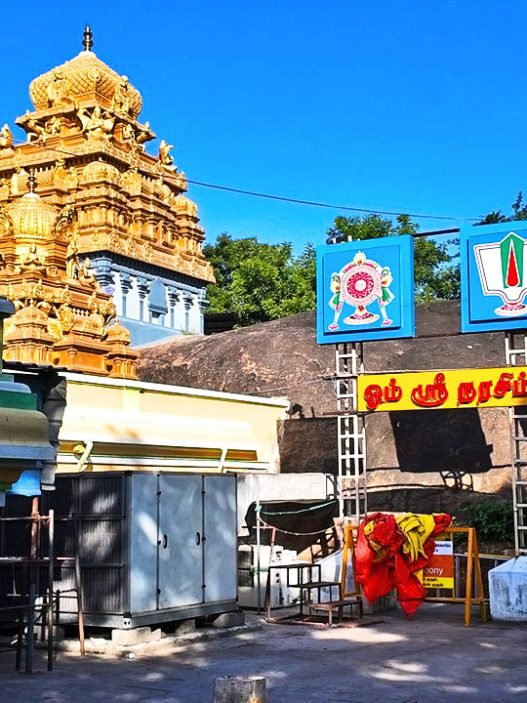
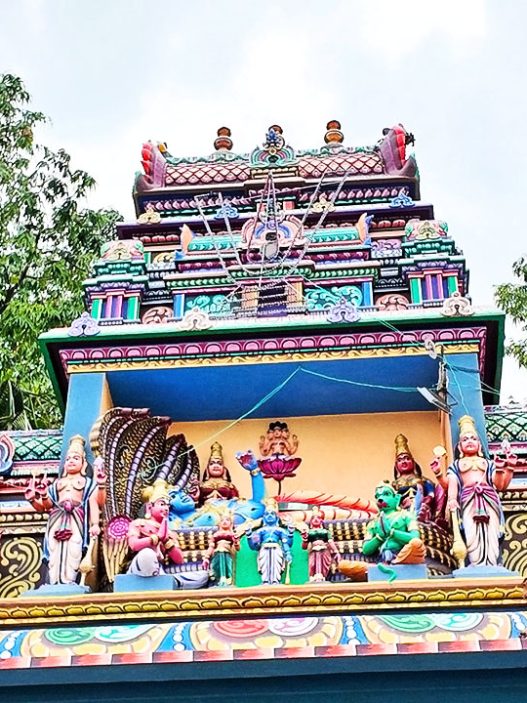
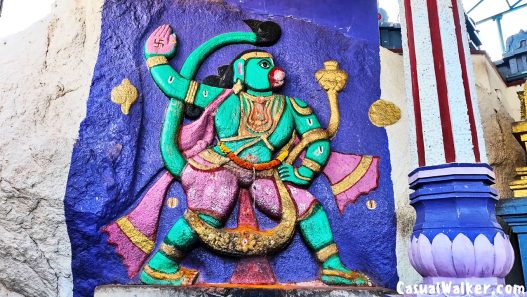
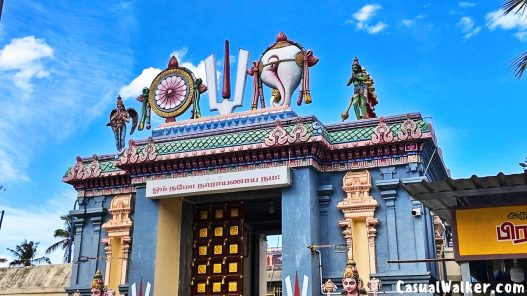
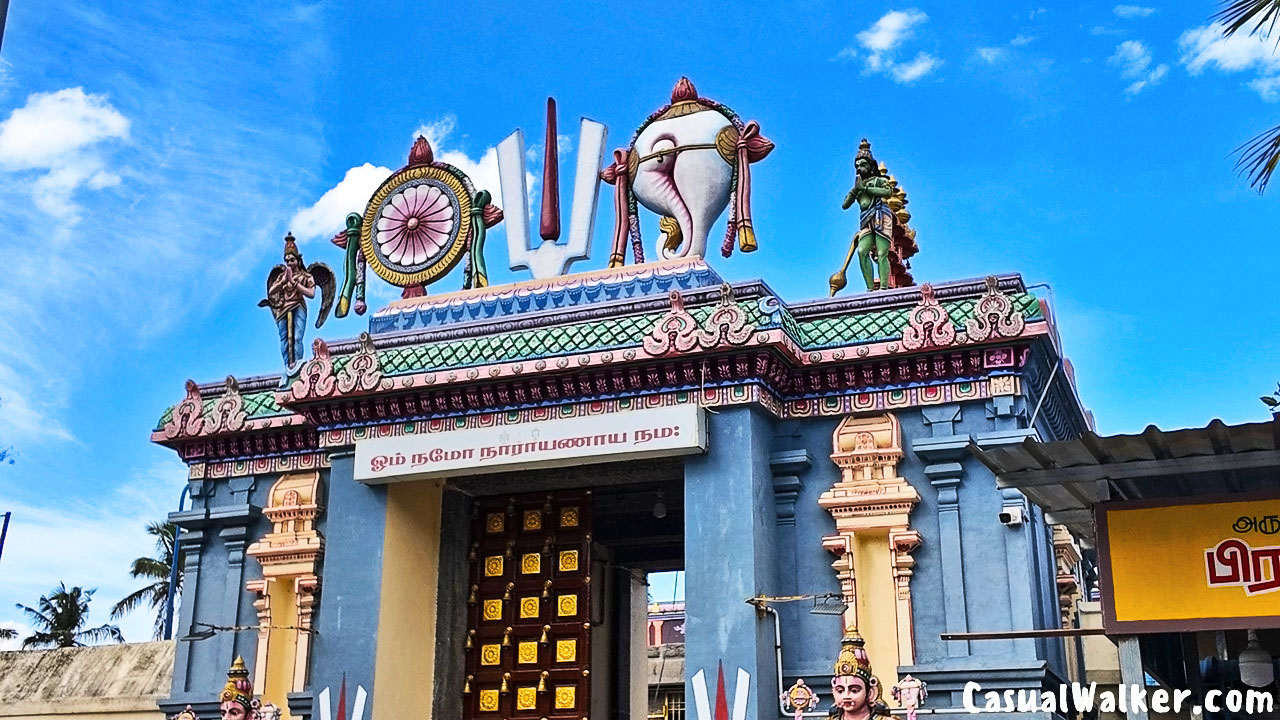
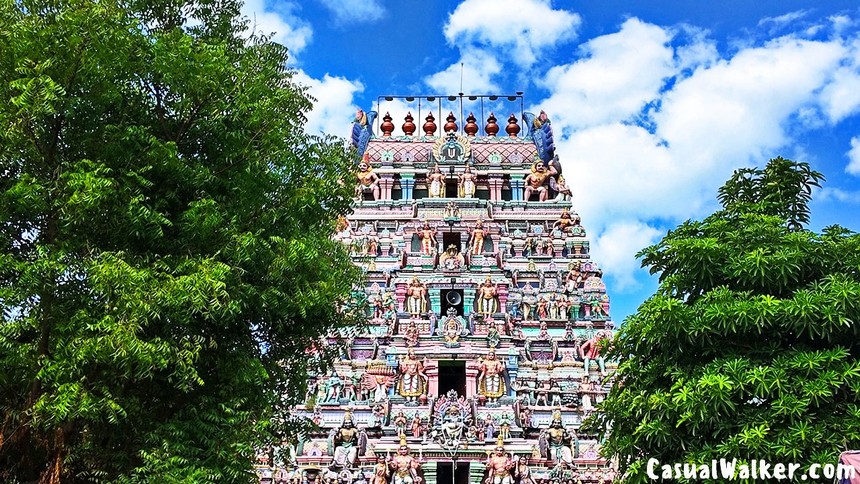
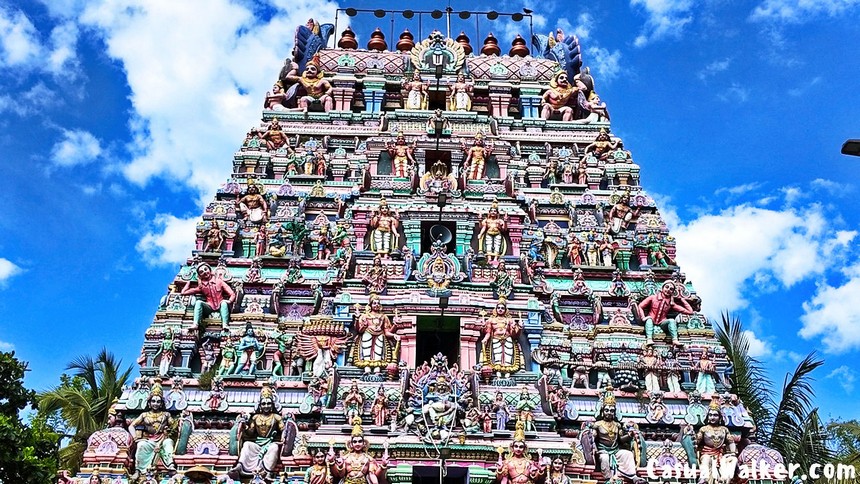
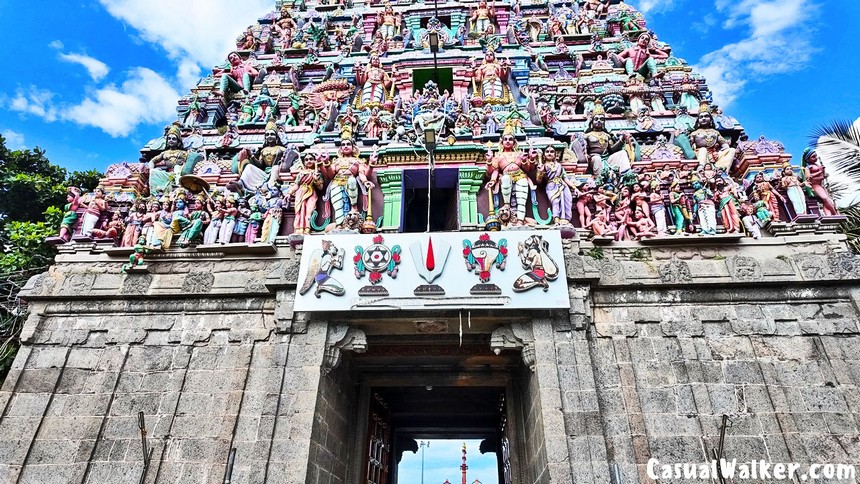
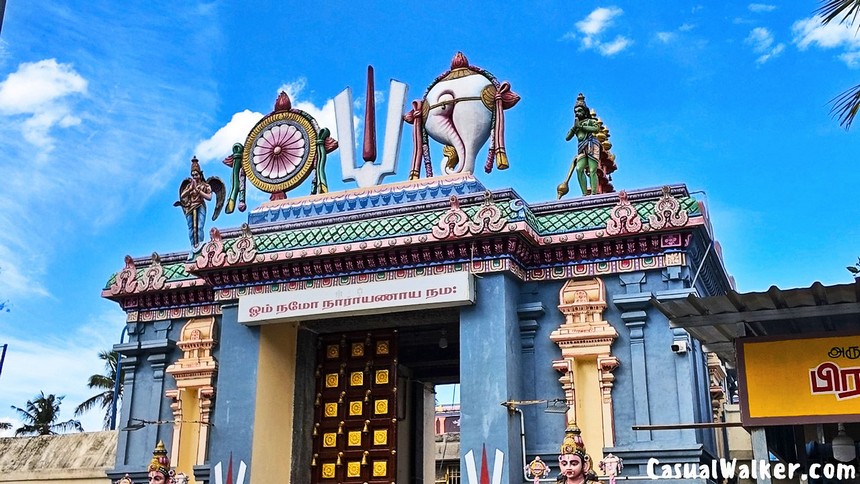
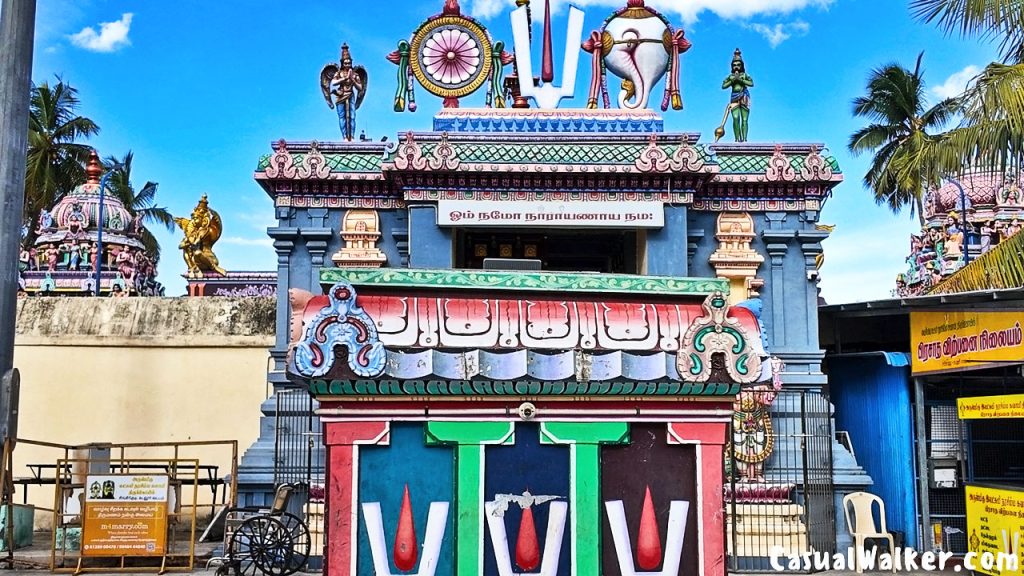
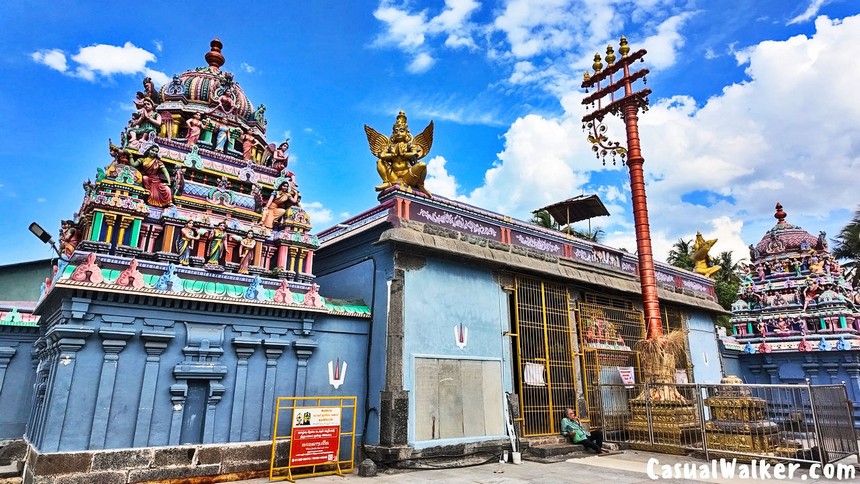
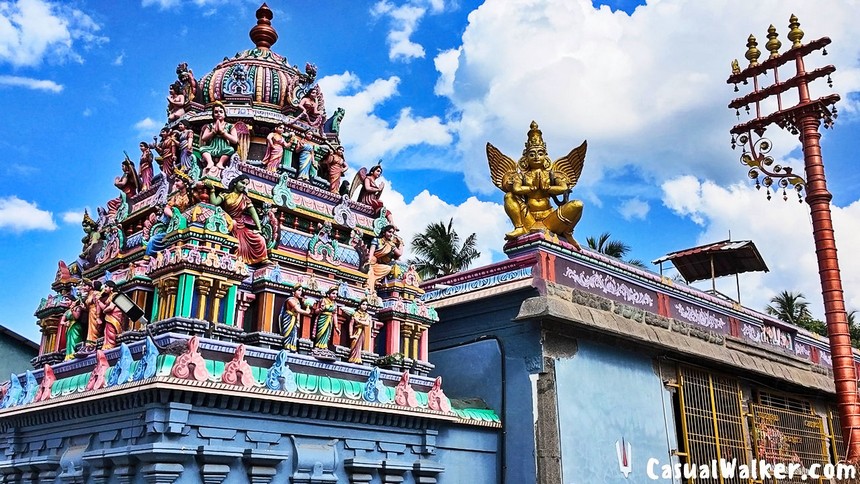
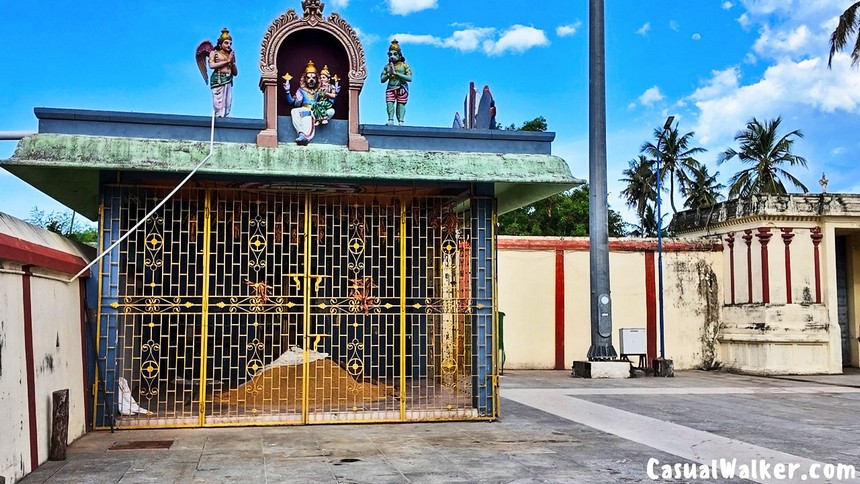
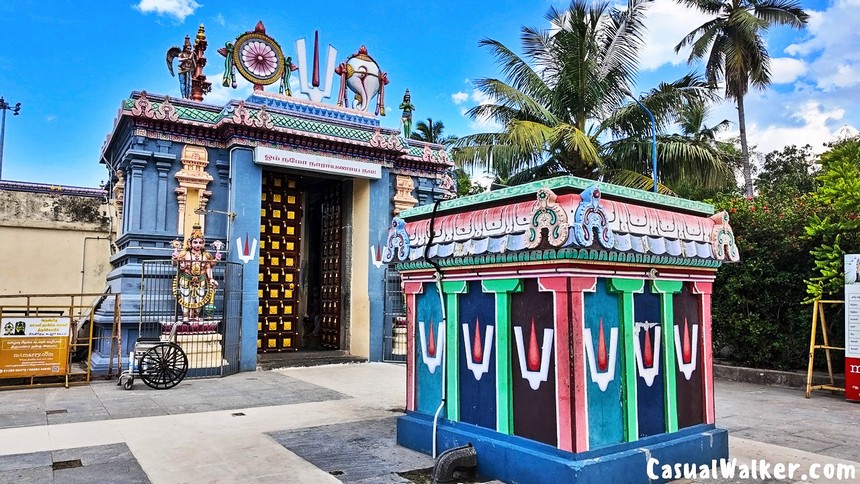
The temple features a five-tiered west-facing Rajagopuram (main entrance tower) that is visible from a distance and serves as the defining landmark of this sacred complex. A tall, gold-plated Dwajastambham (flag post) and two gold-plated Bali Peedams stand prominently at the entrance, and the arch above the entrance bears the symbols of Sangu (conch) and Chakram (discus) along with figures of Lord Anjaneya (Hanuman) and Lord Garudalwar. The Thengalai Thirumann and Sri Choornam (sacred Vaishnava marks) can also be seen between them, and a pair of Dwarapalaka (guardian deity) figures flank either side.
Jamadagni Theertham – Sacred Tank, Pushkarani
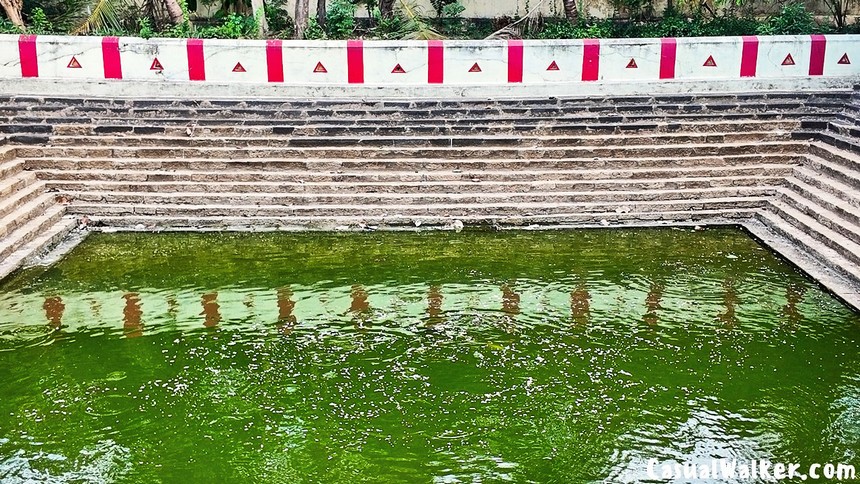
On entering the temple, a large sacred tank (Pushkarani) lies to the right, known by five holy names, Jamadagni Theertham, Bhrigu Theertham, Indira Theertham, Vamana Theertham, and Garuda Theertham. Adjacent to the tank is a designated space for lighting oil lamps, and a Naga Devatha (serpent deity) shrine is located close by. The sacred Peepal tree (Arasa Maram) serves as the Sthala Virutcham (temple tree), and a Neem tree and Peepal tree intertwined together can be seen on the left side of the entrance.
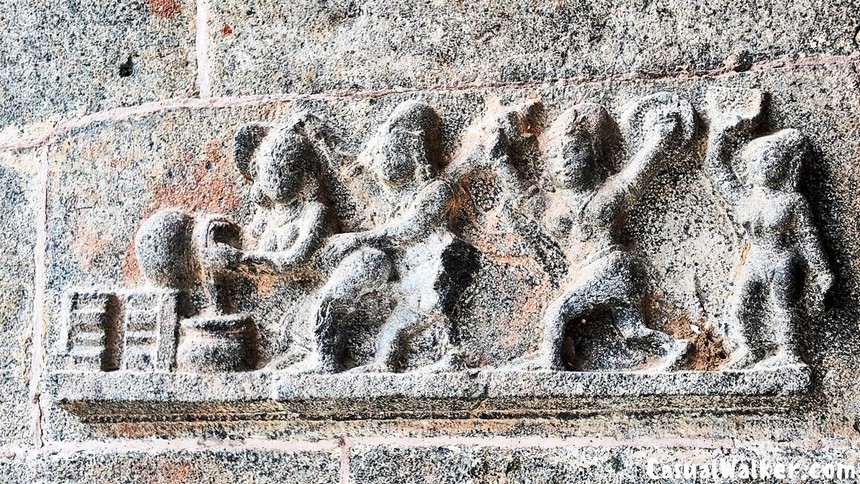
Within the temple complex, a small shrine known as Sri Vikadan Sannidhi houses a Ganapathi idol. On the left side of the Maha Mandapam are two sub-shrines, the first housing Lord Vishwaksenar and Lord Ananthar, and the second housing four Alwar saints facing southward. Lord Garudalwar’s shrine is east-facing and oriented towards the main sanctum.
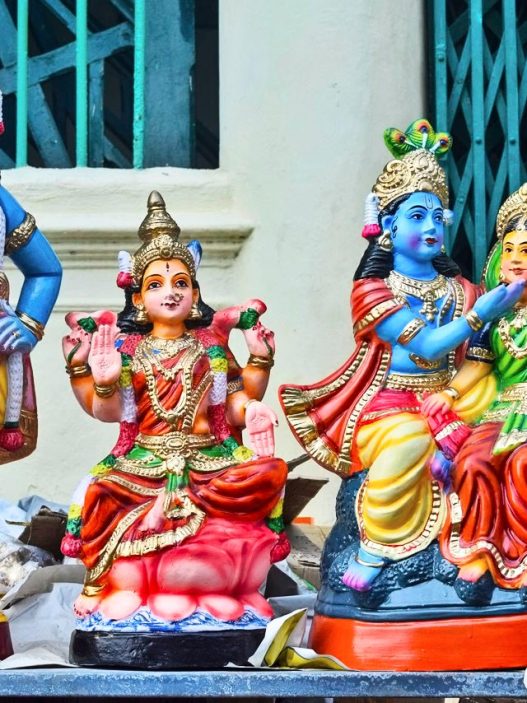
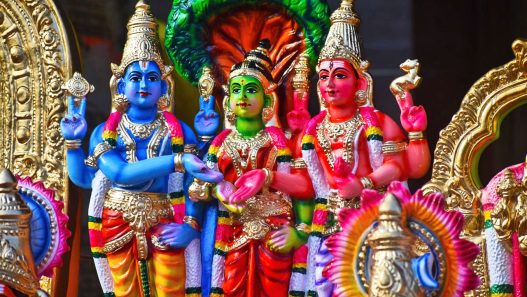
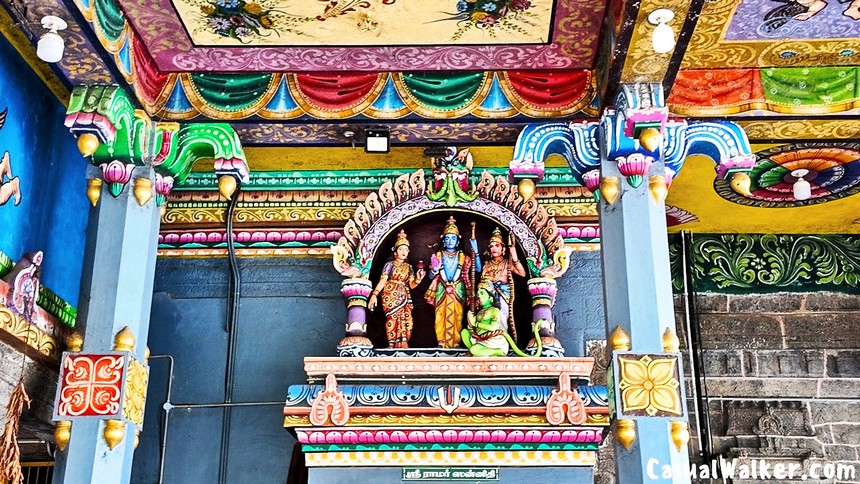
On the outer periphery of the temple is an exclusive east-facing shrine for Devi Kanakavalli Thaayar (the presiding goddess, a form of Goddess Lakshmi), where both the Moolavar and Utsava Thaayar idols are enshrined. Close to the Thaayar Sannidhi is a beautifully painted multi-pillared mandapam housing a south-facing Lord Rama Sannidhi, where Lord Sri Rama, Goddess Seetha, Lord Lakshmana, and Lord Hanuman are depicted as gold-plated vigrahams, with the Utsava Murthy beneath them. Colourful idols of the same divine group are also placed on top of the Rama sub-shrine.
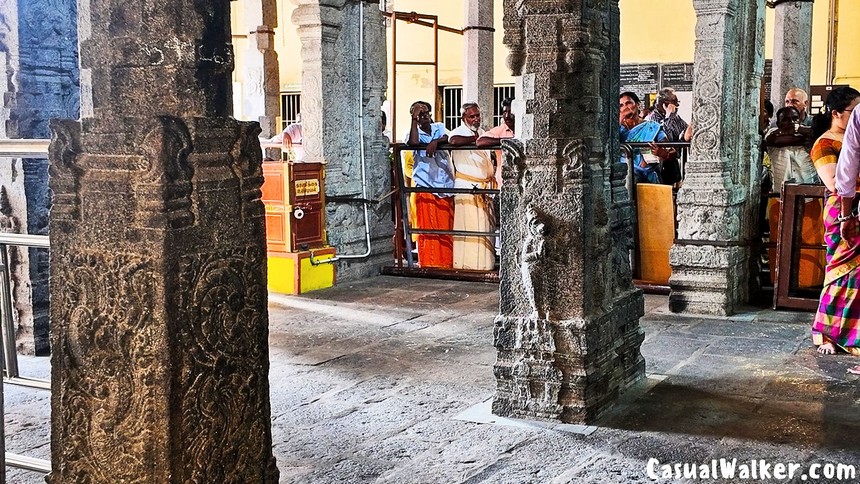
The Andal Sannidhi is east-facing and houses Goddess Andal in a standing posture. Opposite to this is a Yaaga Saalai (Yaaga Mandapam) used for performing Yaagam, Homam, and other sacred rituals. The temple also features a Madapalli (temple kitchen) within the premises and an Annadhana Koodam (free food distribution hall) where prasadam is offered to devotees. The entire temple is surrounded on three sides by a beautifully maintained temple garden (Nandavanam) that adds to the peaceful and meditative atmosphere of this sacred site.
Across from the main temple is an exclusive Lord Anjaneya Sannidhi, and beside it stands the temple chariot (Ther), which is used during the grand annual chariot festival on Narasimha Jayanti.
Kanakavalli Thaayar and Goddess Andal
One of the notable features of this temple is that both Devi Kanakavalli Thaayar (Goddess Lakshmi) and Goddess Andal face the opposite direction to Lord Narasimha, an unusual and symbolically significant arrangement rarely found in other Vaishnava temples. Devi Kanakavalli Thaayar is also described as the divine consort of Lord Narasimha at this sthalam, and her east-facing shrine is maintained separately with full honours, including a dedicated Utsava Thaayar vigraham for festival processions.
Significance as a Nava Narasimha Temple and Navagraha Dosha Nivarana Sthalam
Singirikudi is counted among the nine Nava Narasimha temples of Tamil Nadu, a group of nine sacred Narasimha shrines that together are believed to cover the complete range of Lord Narasimha’s divine manifestations and blessings. Visiting all nine Nava Narasimha temples is considered an extremely meritorious act in the Vaishnava tradition.
In addition, this temple is widely regarded as a Navagraha Dosha Parihaara Sthalam, a sacred place specially powerful for removing the malefic effects of the nine planets. Devotees suffering from Shani Dosha, Rahu-Ketu afflictions, and other planetary imbalances make special trips here to seek Lord Narasimha’s protection and grace.
How and Why to Worship Here
Devotees who are facing difficulties from adverse planetary effects, financial debts, enemy troubles, obstacles in marriage, mental distress, or chronic illnesses traditionally come to this temple and light ghee lamps on Tuesdays, perform archanas (rituals) with Tulasi leaves, and offer sincere prayers to Lord Ugra Narasimha. Those whose wishes have been fulfilled return to perform Thirumanjanam (sacred bath to the Lord), offer new clothes to the deities, and feed fellow devotees as an act of gratitude.
The Swathi Nakshatra days (Lord Narasimha’s birth star) are especially significant here, drawing large gatherings of devotees. Narasimha Jayanti and Vaikunta Ekadasi are also celebrated on a grand scale, with overwhelming attendance from nearby towns and villages.
Festivals at Sri Lakshmi Narasimha Swamy Temple, Singirikudi
The temple hosts a rich calendar of festivals throughout the year. The most important are the Chitrai Vaikasi Brahmotsavam (April–May), a grand ten-day celebration that is the highlight of the temple year; the Chariot Festival on Narasimha Jayanti, when the processional deity is taken through the village streets on the temple chariot; and the Puratasi Saturdays (September–October), which are sacred to Lord Vishnu and draw large numbers of devotees for special abhishekams and archanas.
Three-Temple Circuit: Singirikudi, Poovarasamkuppam, and Parikkalpattu
One of the most cherished pilgrimage traditions connected to this region is the practice of visiting three Sri Lakshmi Narasimha Swamy temples, Singirikudi, Poovarasamkuppam, and Parikkalpattu, in a single day. These three temples fall along the same geographical line and are believed to be intimately connected in their spiritual energy. Completing all three darshans in one day is considered highly auspicious and is said to bring accelerated relief from planetary doshas, enemy troubles, and life obstacles. Many devotees from Pondicherry, Cuddalore, Villupuram, and Chennai make this three-temple circuit a regular practice, particularly on Narasimha Jayanti and Swathi Nakshatra days.

Travel Tips for Visiting Sri Singirikudi Narasimha Temple / Sri Lakshmi Narasimha Swamy Temple, Singirikudi
Sri Singirikudi Narasimha Temple / Sri Lakshmi Narasimha Swamy Temple, Singirikudi Address:
Sri Lakshmi Narasimha Swamy Temple
Singirikudi Village, Abhishekapakkam,
Cuddalore District – 605 007, Tamil Nadu
Phone: 0413-2618755
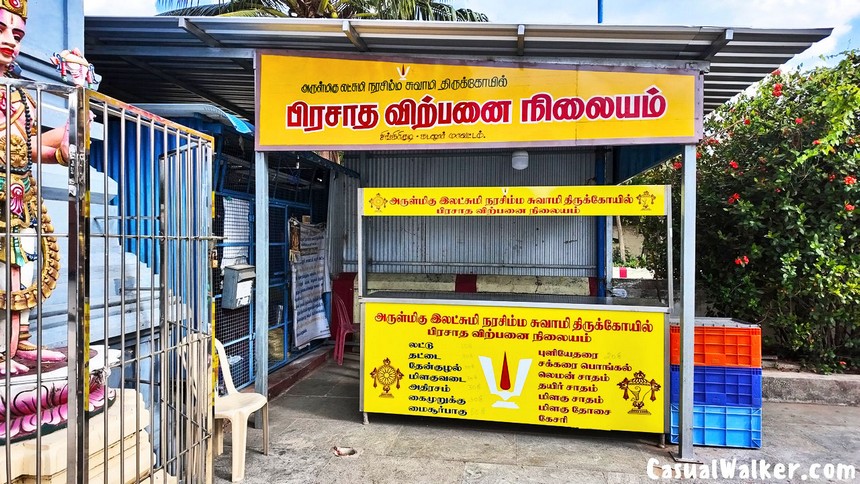
Temple Location: Situated 2 kilometres west of Thavalakuppam, off the Pondicherry–Cuddalore National Highway (NH 332). The temple is located in Singirikudi village, approximately 6 km from Pondicherry on the Pondicherry–Cuddalore road, and 3 km west of the Abhishekapakkam junction. The nearest major city is Pondicherry, and the temple is accessible by bus, auto-rickshaw, or private vehicle from both Pondicherry and Cuddalore. Petty shops selling flowers, garlands, and other devotional items are available near the temple entrance. Devotees should note that dedicated car parking is limited, and vehicles are typically parked along the street leading to the temple.
How To Reach Sri Singirikudi Narasimha Temple / Sri Lakshmi Narasimha Swamy Temple, Singirikudi
By Road: Singirikudi is approximately 160 kilometres from Chennai, and travelling by road is one of the most comfortable and flexible options for visiting this temple. Take the East Coast Road (ECR) or the Chennai–Pondicherry National Highway (NH 32) from Chennai, which passes through Mahabalipuram, Marakkanam, and Tindivanam before reaching Pondicherry — a journey of roughly 3 to 3.5 hours depending on traffic. From Pondicherry, the temple is just 6 kilometres along the Pondicherry–Cuddalore road. You can also take the Chennai–Villupuram route via NH 66 and then proceed to Pondicherry from Villupuram, which takes a similar amount of time. If you are planning the three-temple circuit of Singirikudi, Poovarasamkuppam, and Parikkalpattu in a single day, starting from Chennai by 5 AM is strongly recommended so you can complete all three darshans comfortably before evening.
By Train: The nearest major railway stations to Singirikudi are Pondicherry Railway Station (approximately 6 kilometres away) and Cuddalore Port Junction (approximately 15 kilometres away), both of which are well connected to Chennai. Several trains operate daily between Chennai Egmore and Pondicherry, including the Pondicherry Express and the Chennai Egmore–Pondicherry passenger services, with a journey time of approximately 3.5 to 4 hours. From Pondicherry railway station, the temple can be reached by auto-rickshaw or taxi in around 15 to 20 minutes via the Pondicherry–Cuddalore road. Alternatively, trains from Chennai Egmore to Cuddalore via Villupuram are also available, and from Cuddalore you can hire an auto-rickshaw or taxi to the Abhishekapakkam junction and proceed 3 kilometres west to reach the temple.
By Flight: The nearest airport to Singirikudi is Pondicherry Airport, which currently operates limited domestic flights connecting to a small number of cities. However, for travellers flying from other parts of India or from abroad, Chennai International Airport remains the most practical and well-connected gateway, located approximately 160 kilometres from the temple. From Chennai airport, you can hire a taxi or pre-booked cab directly to Singirikudi, taking the ECR or NH 32 towards Pondicherry — a comfortable 3 to 3.5 hour drive. Several app-based cab services and private tour operators from Chennai offer direct temple tour packages to Singirikudi and the surrounding Nava Narasimha temple circuit, which is a convenient option for outstation devotees flying into Chennai specifically for this pilgrimage.